

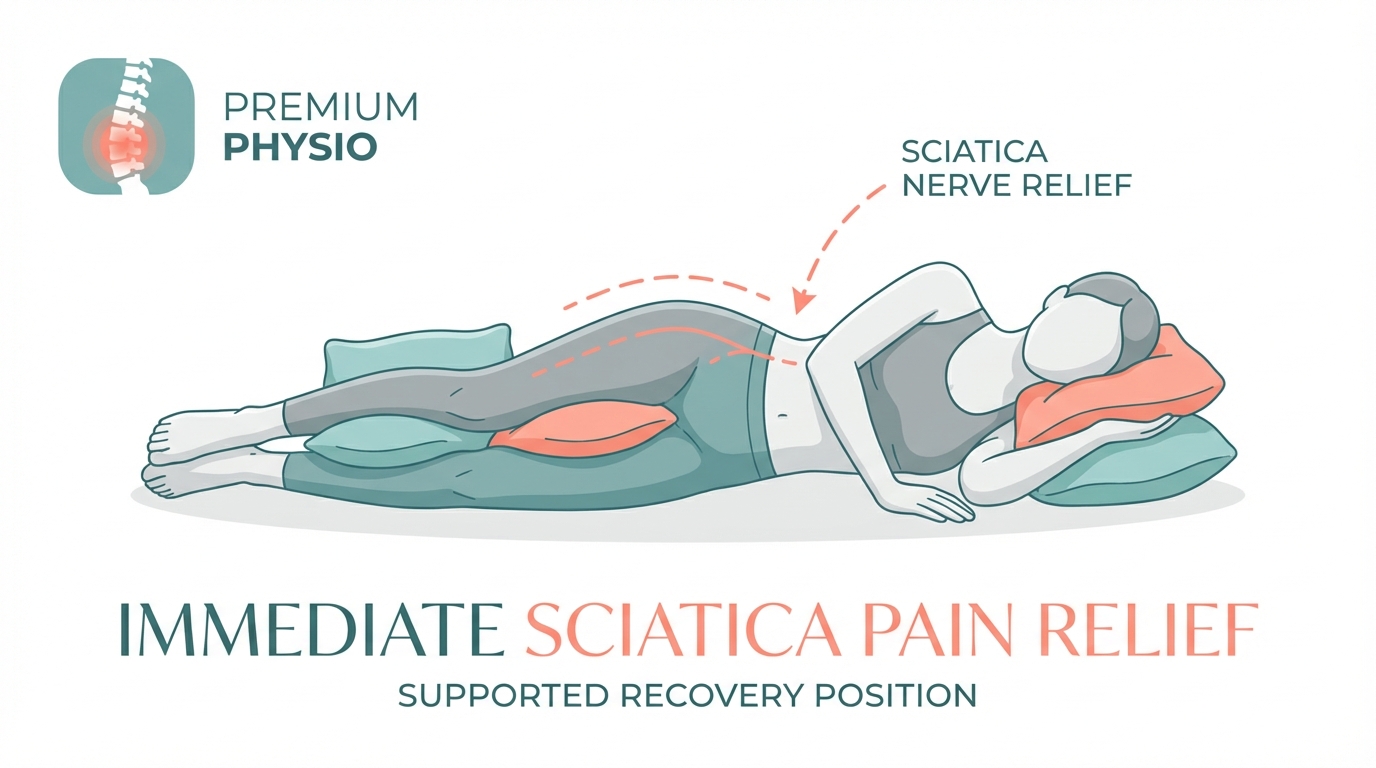
How to Get Immediate Relief from Sciatica Pain
When sciatica flares up, the pain can be severe enough to stop you in your tracks. Burning, shooting sensations radiating from the lower back down the leg can make it difficult to sit, stand, or sleep. The good news is that several evidence-based techniques can provide meaningful short-term relief while your body begins to heal.
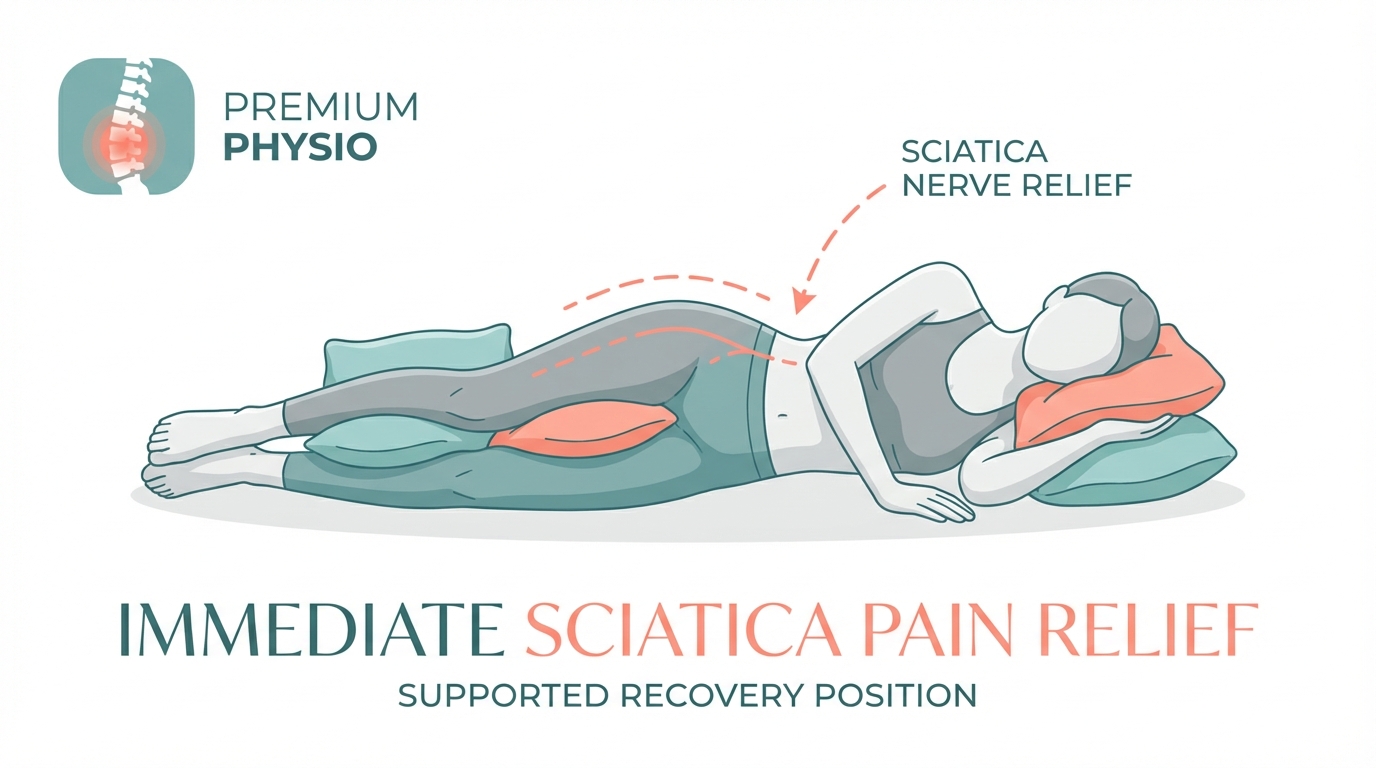
This guide focuses on immediate relief strategies — things you can do right now to reduce acute sciatic nerve pain. These approaches are drawn from physiotherapy practice guidelines and peer-reviewed research, and they complement the longer-term rehabilitation strategies covered in our sciatica relief guide. If you are experiencing your first episode or a sudden flare-up, these techniques may help you manage the pain while you work toward lasting recovery.
What Is Sciatica?
Sciatica refers to pain that travels along the sciatic nerve — the largest nerve in the body, running from the lumbar spine through the buttock and down the back of each leg. It is a symptom rather than a diagnosis, typically caused by compression or irritation of a lumbar nerve root.
Common symptoms include:
- Sharp, shooting, or burning pain from the lower back into the leg
- Numbness or tingling in the leg or foot
- Weakness in the affected leg
- Pain that worsens with sitting, coughing, or sneezing
Most acute sciatica episodes improve within weeks with appropriate management. For a comprehensive overview of the condition, visit our sciatica resource page.
Why Does Sciatica Suddenly Flare Up?
Understanding what triggers acute sciatica can help you avoid worsening the episode. Common triggers include:
- Prolonged sitting or static postures — sustained pressure on lumbar discs increases nerve root irritation
- Heavy lifting with poor mechanics — particularly with a rounded back, which loads the posterior disc
- Sudden twisting movements — rapid rotation under load can shift disc material against a nerve
- Increased inflammation — stress, poor sleep, and inactivity can heighten the body's inflammatory response
- Deconditioning — weak core and spinal stabilizers leave the lumbar spine vulnerable
A flare-up does not necessarily mean new damage has occurred. In many cases, it reflects increased nerve sensitivity or temporary inflammation around an existing issue. This is an important distinction — it means the situation is usually manageable without emergency intervention.
Immediate Positioning Techniques
The fastest way to reduce acute sciatica pain is often to change your position. Certain postures reduce pressure on the lumbar discs and create more space around the irritated nerve root.
90/90 Position (Psoas Release)
What it may help with Reduces intradiscal pressure and takes tension off the sciatic nerve. This is often the first position physiotherapists recommend during an acute episode.
How to do it
- Lie on your back on the floor or a firm surface.
- Place your lower legs on a chair, couch, or ottoman so your hips and knees are both at approximately 90 degrees.
- Rest your arms at your sides with palms facing up.
- Focus on slow, deep breathing — inhale for 4 counts, exhale for 6 counts.
Duration 10–20 minutes. You can repeat this several times throughout the day.
Why it works Research on intradiscal pressure (Wilke et al., 1999) demonstrated that lying supine with hips and knees flexed produces some of the lowest disc pressures of any body position, which can reduce mechanical compression on the nerve root (PMID: 10222525). A 2024 randomized controlled trial (Khan et al., 2024) also found that positional distraction combined with stabilization exercises was more effective than stabilization exercises alone for managing lumbar radiculopathy (PMID: 38219156).
Prone Lying (Face Down)
What it may help with May help centralize pain — moving it from the leg back toward the lower back — in people with disc-related sciatica. Centralization is generally considered a positive sign in rehabilitation.
How to do it
- Lie face down on a firm, flat surface.
- Rest your forehead on your hands or turn your head to one side.
- Let your lower back relax completely — do not actively arch.
- Breathe slowly and allow gravity to gently extend the spine.
Duration 5–10 minutes. If leg pain decreases or moves closer to the spine, this is a favorable response.
Avoid if Pain increases in the leg or travels further from the spine. People with spinal stenosis often find extension positions uncomfortable — if this worsens your symptoms, try the 90/90 position instead.
Side-Lying with Pillow Between Knees
What it may help with Maintains spinal alignment and reduces rotational stress on the lumbar spine. Particularly helpful for sleeping during an acute episode.
How to do it
- Lie on your pain-free side.
- Place a firm pillow between your knees to keep your hips level.
- Slightly bend both knees for comfort.
- Use a supportive pillow under your head to keep your cervical spine neutral.
Duration Use as your primary sleeping position during acute episodes.
Gentle Exercises for Quick Sciatica Relief
During an acute flare-up, aggressive exercise can worsen symptoms. However, specific gentle movements may help reduce pain and prevent stiffening. A systematic review and meta-analysis (Fernandez et al., 2015) found that structured exercise and advice to stay active were both beneficial for sciatica management (PMID: 26165218). A 2021 randomized controlled trial (Fritz et al., 2021) further demonstrated that early physical therapy referral for patients with acute back pain and sciatica led to improvements in disability compared to usual care alone (PMID: 33017565).
Pelvic Tilts
What it may help with Gently activates the deep core muscles without loading the spine, helping to stabilize the lumbar region and reduce spasm.
How to do it
- Lie on your back with knees bent and feet flat on the floor.
- Gently flatten your lower back against the floor by tilting your pelvis upward.
- Hold for 5 seconds, then release.
- The movement should be small and controlled — you are not lifting your hips.
Repetitions 10 repetitions, 2–3 times per day.
Avoid if Stop if this increases pain in the leg. The movement should feel gentle and controlled.
Knee-to-Chest Stretch
What it may help with Opens the lumbar spinal canal and may reduce compression on irritated nerve roots. Often provides relief for stenosis-related sciatica.
How to do it
- Lie on your back with both knees bent.
- Slowly bring one knee toward your chest, holding behind the thigh.
- Hold gently — do not force the stretch.
- Return to the starting position and repeat with the other leg.
Repetitions Hold for 20–30 seconds each side. Repeat 3 times.
Avoid if This position may worsen disc-related sciatica in some people. If pulling the knee in increases leg pain, stop and try prone lying or the press-up instead.
Seated Sciatic Nerve Glide
What it may help with Gently mobilizes the sciatic nerve through surrounding tissues, helping reduce nerve sensitivity without aggressive stretching. A systematic review and meta-analysis (Basson et al., 2017) found that neural mobilization produced clinically meaningful improvements in pain and disability for chronic low back pain (PMID: 28704626). A more recent meta-analysis (Lin et al., 2023) specifically confirmed that neural mobilization is effective for reducing both pain intensity and disability in patients with lumbar radiculopathy (PMID: 38137856).
How to do it
- Sit upright on a firm chair with both feet flat on the floor.
- Slowly straighten the affected leg by extending the knee.
- As you straighten the leg, point your toes toward the ceiling.
- You should feel a gentle pulling sensation — not sharp pain.
- Slowly return to the starting position.
Repetitions 10–15 slow, controlled repetitions. Perform 2–3 times per day.
Avoid if Stop if you experience sharp or shooting pain during the movement. The glide should feel like gentle tension, not a painful stretch.
Standing Back Extension
What it may help with A convenient way to reverse the effects of prolonged sitting. This movement gently extends the lumbar spine, which may help push disc material away from the nerve root in extension-responsive cases.
How to do it
- Stand with feet shoulder-width apart.
- Place your hands on your lower back with fingers pointing downward.
- Slowly lean backward, supporting your spine with your hands.
- Hold for 2–3 seconds at end range, then return to upright.
Repetitions 10 repetitions. Perform every 1–2 hours, especially after sitting.
Avoid if If pain increases in the leg or spreads further from the spine, this direction of movement may not be appropriate for your specific condition. Try flexion-based positions instead.
Heat and Cold Therapy
Thermal therapy is one of the simplest and most accessible forms of immediate sciatica relief.
Cold Therapy (First 48–72 Hours)
During the initial acute phase, cold application can help:
- Reduce inflammation around the nerve root
- Decrease local tissue swelling
- Provide a numbing effect on acute pain
How to apply: Wrap an ice pack or bag of frozen vegetables in a thin towel. Apply to the lower back or buttock area (over the point of maximum pain) for 15–20 minutes. Repeat every 2–3 hours as needed. Never apply ice directly to skin.
Heat Therapy (After Initial Acute Phase)
Once the initial inflammation has settled (typically after 48–72 hours), heat therapy may be more beneficial:
- Relaxes tight muscles that contribute to nerve compression
- Increases blood flow to promote healing
- Reduces muscle spasm and stiffness
How to apply: Use a heating pad, warm towel, or hot water bottle wrapped in a cloth. Apply for 15–20 minutes at a time. Ensure the temperature is warm, not hot enough to burn.
Alternating Heat and Cold
Some people find the greatest relief from alternating between cold and heat — for example, 10 minutes of cold followed by 10 minutes of heat. This approach may help when both inflammation and muscle tension contribute to the pain.
Additional Strategies for Quick Relief
Walking in Short Intervals
Walking is consistently recommended in clinical guidelines as a beneficial activity during sciatica episodes. It promotes blood flow, prevents deconditioning, and can help desensitize the irritated nerve. A 2025 network meta-analysis of 50 randomized controlled trials (Zhu et al., 2025) found that exercise combined with neural mobilization was among the most effective non-surgical interventions for reducing leg pain in sciatica (PMID: 40373933). Start with 10–15 minute walks on flat ground and gradually increase duration as symptoms allow.
Breathing and Relaxation
Pain increases muscle tension, which can worsen nerve compression — creating a cycle that is difficult to break. Focused breathing exercises help:
- Reduce systemic muscle tension
- Lower cortisol and inflammatory markers
- Improve pain tolerance through nervous system regulation
Try diaphragmatic breathing: inhale through your nose for 4 counts, allowing your belly to rise. Exhale slowly through your mouth for 6–8 counts. Practice for 5 minutes during pain peaks.
Supported Sitting
If you must sit during an acute episode, use a rolled towel or small lumbar support cushion in the curve of your lower back. Keep your hips slightly higher than your knees and avoid crossing your legs. Stand and move every 20–30 minutes.
What to Avoid During Acute Sciatica
Certain activities can prolong or worsen an acute episode:
- Prolonged bed rest — more than 1–2 days of inactivity leads to deconditioning and may slow recovery
- Deep forward bends — toe touches and seated forward folds increase disc pressure and nerve tension
- Heavy lifting — particularly with a rounded spine
- High-impact exercise — running, jumping, and explosive movements before acute symptoms settle
- Aggressive stretching — especially hamstring stretches that increase tension on the sciatic nerve
- Sitting on soft, low surfaces — sofas and low chairs increase lumbar flexion and disc pressure
If an activity consistently makes your pain worse or causes symptoms to spread further down the leg, stop and try a different approach.
When to See a Doctor
Most acute sciatica episodes can be managed at home with the strategies described above. However, seek immediate medical evaluation if you experience:
- Loss of bowel or bladder control — difficulty urinating or incontinence
- Rapid progressive weakness — especially foot drop or inability to stand on your toes
- Saddle numbness — loss of sensation in the inner thighs, groin, or buttock area
- Severe pain unresponsive to any position change — pain that does not ease regardless of positioning
These symptoms may indicate cauda equina syndrome, a rare but serious condition that requires urgent surgical evaluation. If in doubt, seek medical advice promptly — early intervention produces better outcomes.
If your pain has not improved after 6–8 weeks of consistent conservative management, consult a physiotherapist or physician for further assessment and imaging if appropriate.
Recovery Timeline
While this guide focuses on immediate relief, understanding the typical recovery trajectory helps set realistic expectations.
Days 1–3: Acute Management
Focus on positioning, gentle movement, and thermal therapy. Pain is often most intense during this window. Use the 90/90 position and cold therapy frequently.
Days 4–14: Early Improvement
Most people notice gradual improvement. Begin incorporating gentle exercises such as pelvic tilts, nerve glides, and short walks. Progress to prone press-ups if extension is comfortable.
Weeks 2–6: Active Rehabilitation
Transition from pain management to structured exercise. For a comprehensive exercise program, see our guide on sciatica exercises. Physical therapy referral during this window tends to produce the best outcomes.
Weeks 6–12: Progressive Recovery
Most sciatica episodes resolve by this stage. Continue building core strength, flexibility, and functional capacity. For specific stretching guidance, see our sciatica stretches guide.
FAQ
What is the fastest way to relieve sciatica pain at home?
The quickest approach combines positioning and cold therapy. Lie in the 90/90 position (on your back with lower legs elevated on a chair) to reduce disc pressure, and apply a cold pack to the painful area for 15–20 minutes. This combination often provides noticeable relief within 20–30 minutes. Follow with gentle walking once pain eases enough to stand comfortably.
Can I exercise during a sciatica flare-up?
Yes, but keep exercises gentle and stop if symptoms worsen. Pelvic tilts, nerve glides, and short walks are generally safe during acute episodes. Avoid high-impact activities, heavy lifting, and aggressive stretching until the acute phase settles. The goal during a flare-up is pain management and gentle movement, not intense rehabilitation.
Is heat or ice better for sciatica?
Both can be helpful at different stages. Cold therapy is generally more effective during the first 48–72 hours when inflammation is highest. After the initial acute phase, heat may be more beneficial for relaxing tight muscles and improving blood flow. Some people find alternating between the two provides the best relief.
How long does a sciatica flare-up last?
Most acute sciatica flare-ups begin to improve within a few days to two weeks with appropriate management. Complete resolution typically takes 4–12 weeks, though this varies depending on the underlying cause and individual factors. If symptoms persist beyond 12 weeks despite consistent conservative care, further investigation may be warranted.
Should I stay in bed with sciatica?
No. Prolonged bed rest is no longer recommended for sciatica. Clinical guidelines consistently advise staying as active as symptoms allow. Brief rest periods in comfortable positions (like the 90/90 position) are fine, but aim to walk and move gently throughout the day. Activity helps maintain muscle strength, promotes circulation, and reduces nerve sensitivity.
When should I go to the emergency room for sciatica?
Seek emergency care if you develop loss of bladder or bowel control, progressive weakness in one or both legs, or numbness in the groin and inner thigh area (saddle numbness). These may indicate cauda equina syndrome, which requires urgent surgical assessment. Severe pain alone, while distressing, is not typically an emergency if neurological function is intact.
References
- Wilke HJ, Neef P, Caimi M, Hoogland T, Claes LE. New in vivo measurements of pressures in the intervertebral disc in daily life. Spine. 1999;24(8):755-762. PMID: 10222525
- Fernandez M, Hartvigsen J, Ferreira ML, et al. Advice to Stay Active or Structured Exercise in the Management of Sciatica: A Systematic Review and Meta-analysis. Spine. 2015;40(18):1457-1466. PMID: 26165218
- Fritz JM, Lane E, McFadden M, et al. Physical Therapy Referral From Primary Care for Acute Back Pain With Sciatica: A Randomized Controlled Trial. Annals of Internal Medicine. 2021;174(1):8-17. PMID: 33017565
- Basson A, Olivier B, Ellis R, Coppieters M, Stewart A, Mudzi W. The Effectiveness of Neural Mobilization for Neuromusculoskeletal Conditions: A Systematic Review and Meta-analysis. Journal of Orthopaedic & Sports Physical Therapy. 2017;47(9):593-615. PMID: 28704626
- Lin CC, Lin YC, Chang CM, Wu LC, Özçakar L. Neural Mobilization for Reducing Pain and Disability in Patients with Lumbar Radiculopathy: A Systematic Review and Meta-Analysis. Life. 2023;13(12):2290. PMID: 38137856
- Khan S, Hasnain S, Soomro RR, Rehmani R. Comparison of positional distraction with stabilisation exercises versus stabilisation exercises alone in the management of lumbar radiculopathy: A randomized controlled-trial. JPMA. 2024;74(1):82-86. PMID: 38219156
- Zhu Z, Schouten R, Strijkers R, Koes B, Gerger H, Chiarotto A. Effectiveness of non-surgical interventions for patients with chronic sciatica: A systematic review with network meta-analysis. The Journal of Pain. 2025. PMID: 40373933
- Zaina F, Côté P, Cancelliere C, et al. A Systematic Review of Clinical Practice Guidelines for Persons With Non-specific Low Back Pain With and Without Radiculopathy. Archives of Physical Medicine and Rehabilitation. 2023;104(11):1913-1927. PMID: 36963709
Looking for a structured sciatica recovery program? Join the RehabGuideHub early access list for guided rehabilitation built with physiotherapy expertise.