

What Are the Best Exercises for Plantar Fasciitis?
The most effective exercises for plantar fasciitis combine stretching with progressive strengthening. Calf stretches and plantar fascia stretches can provide short-term relief, while heavy slow resistance training (such as heel raises with a towel under the toes) has shown superior results at 3 months in clinical research.
This guide covers the exercises that are most commonly used in physiotherapy for plantar fasciitis, organized by category and backed by current evidence.
What Is Plantar Fasciitis?
Plantar fasciitis (increasingly referred to as plantar fasciopathy in clinical settings) is the most common cause of heel pain. It involves irritation and degeneration of the plantar fascia — a thick band of connective tissue that runs along the bottom of your foot from the heel to the toes.
Common characteristics include:
- Sharp pain at the bottom of the heel, especially with the first steps in the morning
- Pain that worsens after prolonged standing or after getting up from sitting
- Tenderness concentrated at the medial heel
- Symptoms that may improve with gentle activity but return after rest
The condition has a reported lifetime incidence of approximately 10% of the population.
Stretching Exercises
Stretching is the most widely prescribed first-line exercise for plantar fasciitis. It targets the calf muscles and the plantar fascia itself.
Calf Stretch (Wall Stretch)
Tight calf muscles increase strain on the plantar fascia. This stretch targets the gastrocnemius.
- Stand facing a wall with your hands flat against it at shoulder height
- Step the affected foot back, keeping the back leg straight and the heel on the floor
- Bend the front knee and lean toward the wall until you feel a stretch in the calf of the back leg
- Hold for 30 seconds
- Repeat 3 times per leg, 2–3 times per day
Soleus Stretch
This targets the deeper calf muscle, which crosses the ankle joint.
- Use the same wall position as above
- Step the affected foot back, but this time bend the back knee slightly while keeping the heel on the floor
- You should feel the stretch lower in the calf, closer to the Achilles tendon
- Hold for 30 seconds
- Repeat 3 times per leg
Plantar Fascia Stretch (Seated)
A targeted stretch for the plantar fascia itself.
- Sit down and cross the affected foot over the opposite knee
- Using your hand, gently pull the toes back toward the shin until you feel a stretch along the arch of the foot
- Hold for 15–30 seconds
- Repeat 10 times
This stretch is often recommended first thing in the morning before getting out of bed, and before standing after prolonged sitting.
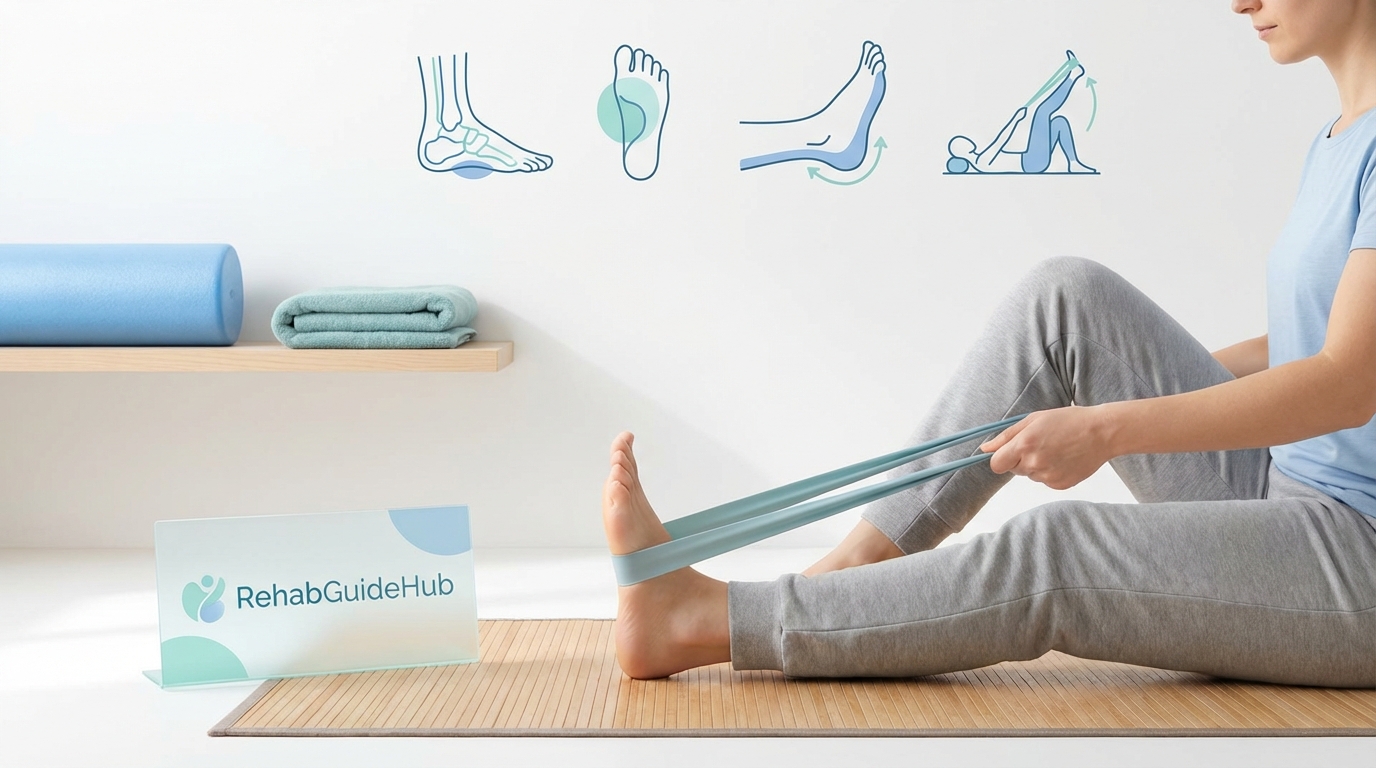
Towel Stretch (Morning)
A practical alternative to the seated plantar fascia stretch.
- Sit on the edge of your bed with a towel or belt within reach
- Loop the towel around the ball of the affected foot
- Gently pull the towel toward you, keeping your knee straight, to stretch the calf and plantar fascia
- Hold for 30 seconds
- Repeat 3 times before standing up
Strengthening Exercises
Evidence increasingly supports progressive loading exercises for plantar fasciitis, not just stretching. A landmark 2015 randomized controlled trial by Rathleff and colleagues found that high-load strength training produced better outcomes at 3 months compared to plantar-specific stretching alone.
Heel Raises with Towel (Rathleff Protocol)
This is the exercise studied in the Rathleff protocol — a high-load strength training approach for plantar fasciitis.
- Roll a towel and place it on the floor
- Stand on a step or thick book with the balls of both feet on the edge and heels hanging off
- Place the toes of the affected foot on the rolled towel (this increases tension on the plantar fascia)
- Slowly raise up onto your toes over 3 seconds
- Hold at the top for 2 seconds
- Lower slowly over 3 seconds
- Perform with both legs initially, progressing to single-leg when able
Starting protocol:
- 3 sets of 12 repetitions, every second day
- Progress by adding weight (holding a dumbbell or wearing a backpack) when you can complete all sets comfortably
Progression:
- Week 1–2: 3 sets of 12 reps (both legs)
- Week 3–4: 4 sets of 10 reps (progressing to single leg)
- Week 5+: 5 sets of 8 reps (single leg, add weight as tolerated)
What to expect: Mild discomfort during the exercise is acceptable and expected. Sharp pain or a significant increase in symptoms the following morning suggests the load was too high.
Single-Leg Heel Raise (Flat Ground)
A simpler starting point if the step-based version is too challenging.
- Stand on the affected foot near a wall or counter for balance
- Slowly raise up onto your toes
- Hold for 2 seconds
- Lower slowly
- Repeat 10–15 times
- Perform 2–3 sets
Intrinsic Foot Strengthening (Short Foot Exercise)
Strengthening the small muscles of the foot can help support the arch.
- Sit or stand with your foot flat on the floor
- Without curling your toes, try to shorten your foot by drawing the ball of the foot toward the heel — as if you are trying to raise the arch
- Hold the contraction for 5–10 seconds
- Repeat 10 times
- Perform 2–3 times per day
This exercise can feel difficult to learn at first. Focus on the arch lifting rather than toe gripping.
Mobility and Self-Massage
Frozen Water Bottle Roll
Combines massage with cold therapy.
- Freeze a water bottle
- Place it on the floor and roll the arch of your foot over it with gentle pressure
- Roll back and forth for 5–10 minutes
- Perform 1–2 times per day, especially after prolonged standing or activity
Tennis Ball Roll
A room-temperature alternative to the frozen bottle.
- Place a tennis ball or lacrosse ball on the floor
- Roll the arch of your foot over the ball with moderate pressure
- Spend extra time on tender areas without pressing through sharp pain
- Roll for 2–5 minutes per foot
Exercises to Avoid with Plantar Fasciitis
Certain activities can worsen plantar fasciitis symptoms:
- High-impact activities like running or jumping before symptoms have settled
- Walking barefoot on hard surfaces for prolonged periods
- Excessive toe curling exercises, which may irritate the plantar fascia further
- Aggressive stretching that causes sharp pain at the heel
Gradual return to activity is important. Reduce impact until morning pain consistently improves.
When to See a Clinician
Seek professional evaluation if:
- Heel pain does not improve after 4–6 weeks of consistent exercise and load management
- Pain is severe enough to limit daily walking
- You notice swelling, bruising, or warmth at the heel
- Symptoms appeared suddenly after an injury or impact
A physiotherapist can assess your foot mechanics, identify contributing factors such as calf tightness or ankle stiffness, and build a tailored rehabilitation program.
Recovery Expectations
Plantar fasciitis is normally considered a self-limiting condition, but symptoms often persist for several months to over a year. Multiple treatments are available, but no single treatment has been shown to be clearly superior to others.
Progressive loading (high-load strength training) may lead to faster improvement in the first 3 months compared to stretching alone, based on the Rathleff et al. (2015) trial. However, by 12 months, both groups showed similar outcomes — suggesting that consistency with any appropriate exercise approach matters most.
FAQ
How long does plantar fasciitis take to heal?
Most people see meaningful improvement within 3–6 months with consistent exercise and load management. Some cases resolve sooner, while chronic cases may take up to a year or longer. Early intervention and appropriate loading typically lead to faster recovery.
Should I rest or exercise with plantar fasciitis?
Relative rest (reducing aggravating activities) is helpful, but complete rest is not recommended. Progressive loading through exercises like heel raises has been shown to be more effective than rest alone. The goal is to find the right balance between activity and recovery.
Is walking good for plantar fasciitis?
Moderate walking is generally acceptable, but prolonged walking on hard surfaces or barefoot walking may worsen symptoms. Wearing supportive shoes and keeping walks to a tolerable duration can help. If walking significantly increases your morning pain the following day, reduce the volume.
Do heel insoles help plantar fasciitis?
Heel cups and insoles are commonly used alongside exercises. Research trials, including those by Riel and Rathleff, have used heel cups as part of the baseline treatment for all groups. While insoles alone may not resolve the condition, they can provide symptom relief while you build strength through exercises.
What is the Rathleff protocol?
The Rathleff protocol is a high-load strength training program for plantar fasciitis developed by researchers at Aalborg University, Denmark. It involves performing slow heel raises on a step with a towel under the toes, progressing in load over time. A 2015 randomized controlled trial showed it produced faster improvement at 3 months compared to stretching alone.
Can plantar fasciitis come back?
Yes. Recurrence is common, especially if the underlying factors (calf tightness, sudden increases in activity, inadequate footwear) are not addressed. Maintaining a regular strengthening and stretching routine can help reduce the risk of recurrence.
References
- Rathleff MS, Molgaard CM, Fredberg U, et al. High-load strength training improves outcome in patients with plantar fasciitis: A randomized controlled trial with 12-month follow-up. Scandinavian Journal of Medicine and Science in Sports. 2015;25(3):e292-e300.
- Riel H, Vicenzino B, Olesen JL, et al. Corticosteroid injection plus exercise versus exercise, beyond advice and a heel cup for patients with plantar fasciopathy: protocol for a randomised clinical superiority trial (the FIX-Heel trial). Trials. 2020;21(1):49.
- Riel H, Jensen MB, Olesen JL, et al. Self-dosed and pre-determined progressive heavy-slow resistance training have similar effects in people with plantar fasciopathy: a randomised trial. Journal of Physiotherapy. 2019;65(3):154-161.
- Riel H, Vicenzino B, Olesen JL, et al. Does a corticosteroid injection plus exercise or exercise alone add to the effect of patient advice and a heel cup for patients with plantar fasciopathy? A randomised clinical trial. British Journal of Sports Medicine. 2023;57(22):1438-1444.
Looking for guided plantar fasciitis recovery? Join the RehabGuideHub early access list for structured rehabilitation programs built with physiotherapy expertise.