

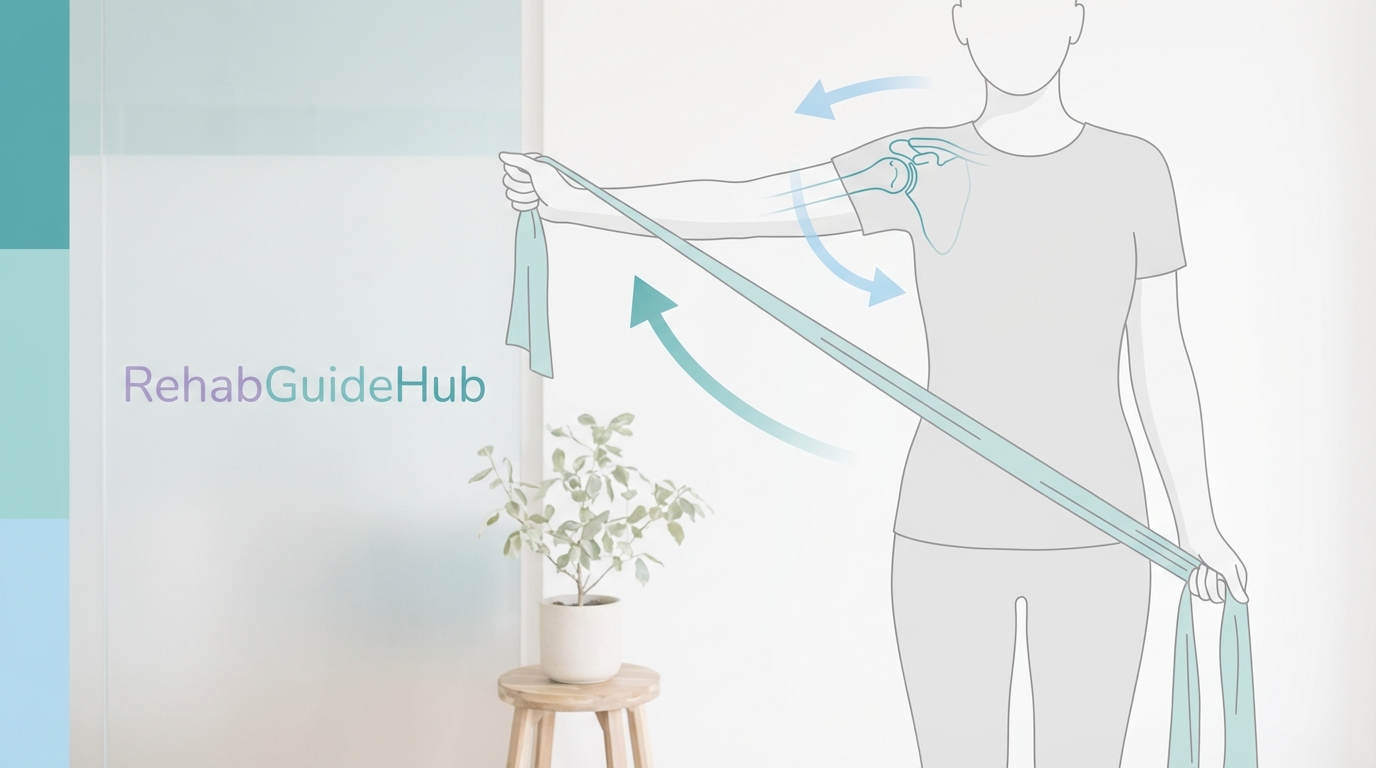
What Are the Best Rotator Cuff Exercises to Do at Home?
The most effective home exercises for rotator cuff rehabilitation target three areas: range of motion recovery, rotator cuff strengthening, and scapular stability. Isometric exercises are typically the starting point, progressing to resistance band and light dumbbell exercises as pain allows.
Conservative treatment based on exercise is the first-line approach for most rotator cuff injuries, including tendinopathy, partial tears, and even some full-thickness tears in older adults. A 2025 systematic review and meta-analysis (Hernandez-Sanchez et al.) examined the effect of home exercise programs for non-tear rotator cuff-related shoulder pain, confirming the positive role of therapeutic exercise in this population.
Understanding the Rotator Cuff
The rotator cuff is a group of four muscles and their tendons that stabilize the shoulder joint:
- Supraspinatus — initiates arm lifting (abduction) and is the most commonly injured rotator cuff muscle
- Infraspinatus — externally rotates the arm
- Teres minor — assists with external rotation
- Subscapularis — internally rotates the arm
These muscles work together to keep the head of the humerus (upper arm bone) centered in the shallow shoulder socket during movement. When one or more of these muscles is weakened, injured, or inflamed, the shoulder becomes unstable and painful.
Common rotator cuff conditions include:
- Rotator cuff tendinopathy — irritation and degeneration of the tendons without a tear
- Partial rotator cuff tear — incomplete tear of one or more tendons
- Full-thickness rotator cuff tear — complete tear through the tendon
- Subacromial impingement — compression of the rotator cuff tendons beneath the acromion
Phase 1: Pain Management and Range of Motion
Start here if your shoulder is currently painful and stiff. The goal is to reduce pain and restore basic range of motion before strengthening.
Pendulum Exercise
A gentle starting exercise that uses gravity to create passive movement.
- Lean forward slightly, supporting yourself with your unaffected arm on a table or chair
- Let the affected arm hang freely
- Gently swing the arm in small circles — clockwise, then counterclockwise
- Then swing forward and backward, and side to side
- Perform for 1–2 minutes in each direction
- Repeat 2–3 times per day
This exercise should be nearly pain-free. The movement comes from shifting your body weight, not from actively moving the shoulder.
Assisted Shoulder Flexion (Supine)
- Lie on your back holding a stick, cane, or umbrella with both hands
- Starting with the stick at your waist, slowly raise it overhead using both arms — the unaffected arm assists the affected side
- Go only as far as is comfortable without sharp pain
- Hold for 5 seconds at the top, then slowly lower
- Repeat 10 times
Assisted External Rotation (Supine)
- Lie on your back with your elbows bent to 90 degrees and close to your sides
- Hold a stick with both hands
- Using the unaffected arm, gently push the affected arm outward (externally rotate) by moving the stick
- Stop when you feel a comfortable stretch
- Hold for 5 seconds, then return
- Repeat 10 times
Phase 2: Isometric Strengthening
Isometric exercises contract the muscle without moving the joint. These are useful for building early strength when movement is still painful.
Isometric External Rotation
- Stand with your affected side next to a wall or door frame
- Bend the elbow to 90 degrees with a small towel between your elbow and your side
- Press the back of your hand into the wall as if trying to rotate your forearm outward
- Hold for 5–10 seconds at approximately 50% effort
- Repeat 10 times
- Perform 2–3 times per day
Isometric Internal Rotation
- Stand facing a wall or door frame
- Bend the elbow to 90 degrees
- Press the palm of your hand into the wall as if trying to rotate your forearm inward
- Hold for 5–10 seconds at approximately 50% effort
- Repeat 10 times
Isometric Shoulder Abduction
- Stand with the affected side next to a wall
- Bend the elbow to 90 degrees
- Press the outer side of your elbow into the wall as if trying to raise your arm out to the side
- Hold for 5–10 seconds
- Repeat 10 times
Phase 3: Active Strengthening with Resistance
Progress to this phase when isometric exercises are comfortable and pain is well managed. A light resistance band or light dumbbells (1–3 kg) are sufficient for most people.
External Rotation with Resistance Band
The most important rotator cuff strengthening exercise.
- Attach a resistance band to a door handle at elbow height
- Stand with your affected side away from the door
- Hold the band with the affected arm, elbow bent to 90 degrees and pinned to your side
- Rotate your forearm outward against the band's resistance
- Slowly return to the starting position
- Perform 3 sets of 10–15 repetitions
Common mistakes: Allowing the elbow to drift away from the body, using a band that is too strong, or performing the movement too quickly.
Internal Rotation with Resistance Band
- Same setup, but stand with your affected side toward the door
- Pull the band across your body (rotating your forearm inward)
- Slowly return
- Perform 3 sets of 10–15 repetitions
Side-Lying External Rotation
A dumbbell-based alternative to the resistance band exercise.
- Lie on your unaffected side with the affected arm on top
- Hold a light dumbbell (1–2 kg to start) with the elbow bent to 90 degrees and resting on your side
- Slowly rotate the forearm upward toward the ceiling
- Lower slowly
- Perform 3 sets of 10–15 repetitions
Prone Y, T, and I Raises
These target the lower trapezius and rotator cuff in a prone position.
- Lie face down on a bed or bench with the affected arm hanging off the edge
- With your thumb pointing upward:
- Y raise: Lift the arm at a 45-degree angle overhead
- T raise: Lift the arm straight out to the side
- I raise: Lift the arm straight alongside your body
- Hold each raise for 2–3 seconds at the top
- Perform 10 repetitions per direction
- Start without weight, then progress to 0.5–1 kg
Phase 4: Scapular Stability
Scapular control is essential for rotator cuff function. Poor scapular positioning can contribute to impingement and slow recovery.
Wall Slides
- Stand with your back against a wall, feet about 30 cm from the wall
- Place your arms against the wall with elbows bent to 90 degrees (like a goalpost position)
- Slowly slide your arms upward along the wall, straightening your elbows
- Keep your wrists, elbows, and back in contact with the wall throughout
- Return to the starting position
- Repeat 10–15 times
Scapular Squeezes
- Sit or stand upright with your arms at your sides
- Squeeze your shoulder blades together as if you are trying to hold a pencil between them
- Hold for 5 seconds
- Release
- Repeat 15 times
Serratus Anterior Punch (Wall Push-Up Plus)
- Stand facing a wall with your hands flat at shoulder height
- Perform a wall push-up
- At the top of the push-up, push further by protracting your shoulder blades (rounding your upper back slightly)
- Return to the starting position
- Repeat 10–15 times
Exercises to Approach with Caution
Some common exercises can irritate the rotator cuff, particularly during recovery:
- Overhead pressing (military press, shoulder press) — places high load on potentially inflamed tendons
- Upright rows — can impinge the supraspinatus tendon
- Lateral raises above 90 degrees — may increase subacromial compression
- Behind-the-neck movements — places the shoulder in a vulnerable position
- Heavy bench pressing — high load in a position that stresses the anterior shoulder
These exercises are not necessarily permanently off-limits, but should be reintroduced gradually and only when strength and pain levels allow.
When to See a Clinician
Seek professional evaluation if:
- Shoulder pain does not improve after 4–6 weeks of consistent exercise
- You cannot raise your arm or perform daily activities due to weakness
- You experienced a traumatic injury (fall, sudden pull) followed by immediate weakness
- Pain wakes you at night and does not respond to positional changes
- You notice significant muscle wasting around the shoulder
A physiotherapist can perform specific clinical tests, assess your movement patterns, and determine whether imaging is needed. Not all rotator cuff tears require surgery — many partial and even full-thickness tears can be managed conservatively with appropriate rehabilitation.
Recovery Expectations
Recovery timelines depend on the severity of the condition:
- Mild tendinopathy: 4–8 weeks with consistent exercise
- Moderate tendinopathy or partial tear: 3–6 months of progressive rehabilitation
- Post-surgical repair: 4–6 months before return to most activities, with continued strengthening for up to a year
A structured, progressive approach — moving from pain management through range of motion, isometric strengthening, active strengthening, and functional exercises — produces better outcomes than jumping directly to heavy strengthening.
FAQ
Can I fix a rotator cuff tear without surgery?
Many rotator cuff tears, particularly partial tears and degenerative full-thickness tears, can be managed effectively with exercise-based rehabilitation. A 2025 review (Kim and Jeong) confirmed that conservative management including exercise is the first-line treatment for rotator cuff conditions, especially in older adults. Surgery is typically considered when conservative treatment fails after several months or when the tear is acute and traumatic with significant functional loss.
How long does rotator cuff recovery take?
Recovery from mild tendinopathy may take 4–8 weeks. More significant injuries typically require 3–6 months of consistent rehabilitation. Post-surgical recovery often takes 4–6 months before return to most activities.
Should I use ice or heat for rotator cuff pain?
Ice can help manage acute inflammation and post-exercise soreness. Heat may be more helpful before exercise to relax muscles and improve blood flow. Use whichever provides more relief for your situation. Applying ice for 15–20 minutes after exercise is a common approach.
What resistance band should I use?
Start with the lightest resistance band available (usually yellow or red in standard sets). You should be able to complete the full prescribed repetitions with good form. If the last 2–3 reps are challenging but manageable, the resistance is appropriate. Progress to the next band when exercises feel easy.
Can I do these exercises every day?
Isometric exercises and range of motion exercises can typically be performed daily. Resistance exercises (bands or dumbbells) are better performed every other day to allow recovery. Listen to your shoulder — if soreness from the previous session has not resolved, give it an additional rest day.
Is it normal for exercises to cause some pain?
Mild discomfort during or after exercise is acceptable, especially in the early phases. However, sharp pain during a specific movement, pain that lasts more than a few hours after exercise, or a significant increase in night pain suggests the exercise is too aggressive. Reduce the load or range of motion and reassess.
References
- Hernandez-Sanchez S, Segura-Heras JV, Andreu-Conde I, et al. Effect of home exercise programs in patients with non-tears rotator cuff-related shoulder pain: a systematic review and meta-analysis. European Journal of Physical and Rehabilitation Medicine. 2025.
- Kim TH, Jeong HJ. Conservative treatment of older adult patients with shoulder diseases: a narrative review. Ewha Medical Journal. 2025.
- Turkmen C, Kus S, Yeldan I. Effectiveness of the therapeutic rehabilitation methods applied to scapula on rotator cuff pathologies: A systematic review of randomized controlled trials. Journal of Hand Therapy. 2026.
- Nartea R, Ghiorghiu Z, Alexe CI, et al. Current Concepts in Pathogenesis and Conservative Management of Supraspinous Tendinopathies Using Shockwave Therapy. Biomedicines. 2025;13(5).
Ready for guided shoulder rehabilitation? Join the RehabGuideHub early access list for structured recovery programs built with physiotherapy expertise.