

Sciatica pain is often at its worst first thing in the morning. Hours of lying still can leave the sciatic nerve sensitized, the surrounding muscles stiff, and every movement from rolling over to standing up painful. The good news is that a short routine of gentle exercises — performed right in bed — can ease that morning stiffness and set the tone for a more comfortable day. This guide covers five supine stretches that require no equipment, no mat, and no getting on the floor.

Why Sciatica Feels Worse in the Morning
During sleep, spinal discs rehydrate and expand slightly, which can increase pressure on irritated nerve roots. At the same time, muscles and connective tissue stiffen from inactivity. The combination of swollen discs and tight muscles creates a narrow window where any sudden movement — even something as simple as sitting up — can trigger a sharp flare.
Gentle in-bed exercises work by:
- Promoting blood flow to the lower back and legs before you stand
- Gradually mobilizing the sciatic nerve through surrounding tissues
- Activating deep stabilizers like the pelvic floor and transversus abdominis
- Reducing disc pressure through controlled spinal movements
A 2015 systematic review and meta-analysis (Fernandez et al.) found that structured exercise produced better outcomes than advice to stay active alone for managing sciatica symptoms (PMID: 26165218). Starting those exercises as early as possible in the day — even before leaving bed — aligns with this evidence.
What Is Sciatica?
Sciatica describes pain that follows the path of the sciatic nerve — the longest nerve in your body, running from the lower back through the buttock and down the back of each leg. It is a symptom of an underlying condition, not a diagnosis in itself.
Common causes include:
- Herniated lumbar disc — disc material presses on a spinal nerve root
- Piriformis syndrome — the piriformis muscle tightens around the sciatic nerve
- Spinal stenosis — narrowing of the spinal canal compresses the nerve
- Degenerative disc disease — age-related changes reduce space around the nerve
Symptoms typically affect one side and may include shooting pain, numbness, tingling, or weakness. For a complete overview, see our sciatica condition page.
5 Sciatica Exercises You Can Do in Bed
The exercises below are designed to be performed on a firm mattress. If your mattress is very soft, consider placing a folded blanket on top for extra support. A 2025 network meta-analysis (Zhu et al.) examining 50 randomized controlled trials found that exercise combined with neural mobilization produced some of the largest short-term reductions in leg pain for chronic sciatica (PMID: 40373933).
Knee-to-Chest Stretch

What it helps with Gently opening the lumbar spine to reduce pressure on compressed nerve roots and relieve general lower back tightness.
How to do it
- Lie on your back with both knees bent and feet flat on the mattress.
- Slowly bring one knee toward your chest, holding behind the thigh — not on top of the kneecap.
- Keep the opposite foot flat and your lower back relaxed against the bed.
Repetitions Hold for 30 seconds each side. Repeat 2–3 times.
When to stop Stop if pulling the knee toward your chest increases leg pain or produces numbness below the knee.
Supine Piriformis Stretch

What it helps with Releasing tension in the piriformis muscle, which sits deep in the buttock and can compress the sciatic nerve — especially relevant when piriformis syndrome is the underlying cause.
How to do it
- Lie on your back with both knees bent.
- Cross your right ankle over your left knee to create a figure-4 shape.
- Gently pull your left thigh toward your chest until you feel a deep stretch in the right buttock.
Repetitions Hold for 30 seconds each side. Repeat 2–3 times.
When to stop Stop if the stretch produces sharp pain or if symptoms travel further down the leg rather than easing.
Pelvic Tilt

What it helps with Activating the deep core muscles — particularly the transversus abdominis — and gently mobilizing the lumbar spine. This small movement helps "wake up" your stabilizers before any larger movements.
How to do it
- Lie on your back with knees bent and feet flat on the mattress.
- Gently flatten your lower back into the bed by tilting your pelvis upward.
- Hold for 5 seconds, then release to a neutral position.
Repetitions 10 repetitions. Rest briefly, then repeat for a second set.
When to stop Stop if you feel sharp pain in the lower back or if symptoms radiate into the leg during the movement.
Lying Spinal Twist
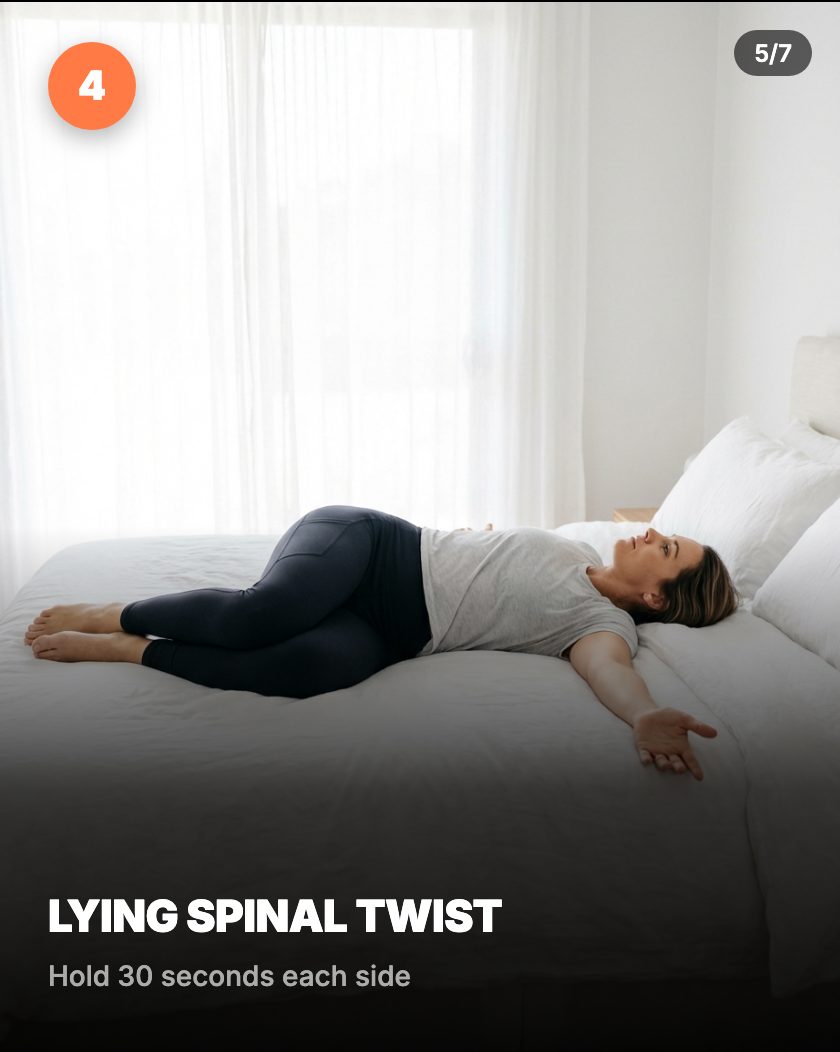
What it helps with Gently rotating the lumbar and thoracic spine to release tension in the lower back, hips, and surrounding muscles. This stretch can help decompress the area around the sciatic nerve.
How to do it
- Lie on your back with both knees bent and arms extended out to the sides.
- Slowly drop both knees to one side, keeping your shoulders flat against the bed.
- Turn your head to look in the opposite direction of your knees.
Repetitions Hold for 30 seconds each side. Repeat 2 times.
When to stop Stop if the twist increases leg pain or if you feel a sharp catch in the lower back. Keep the movement slow and controlled — never force the rotation.
Sciatic Nerve Glide
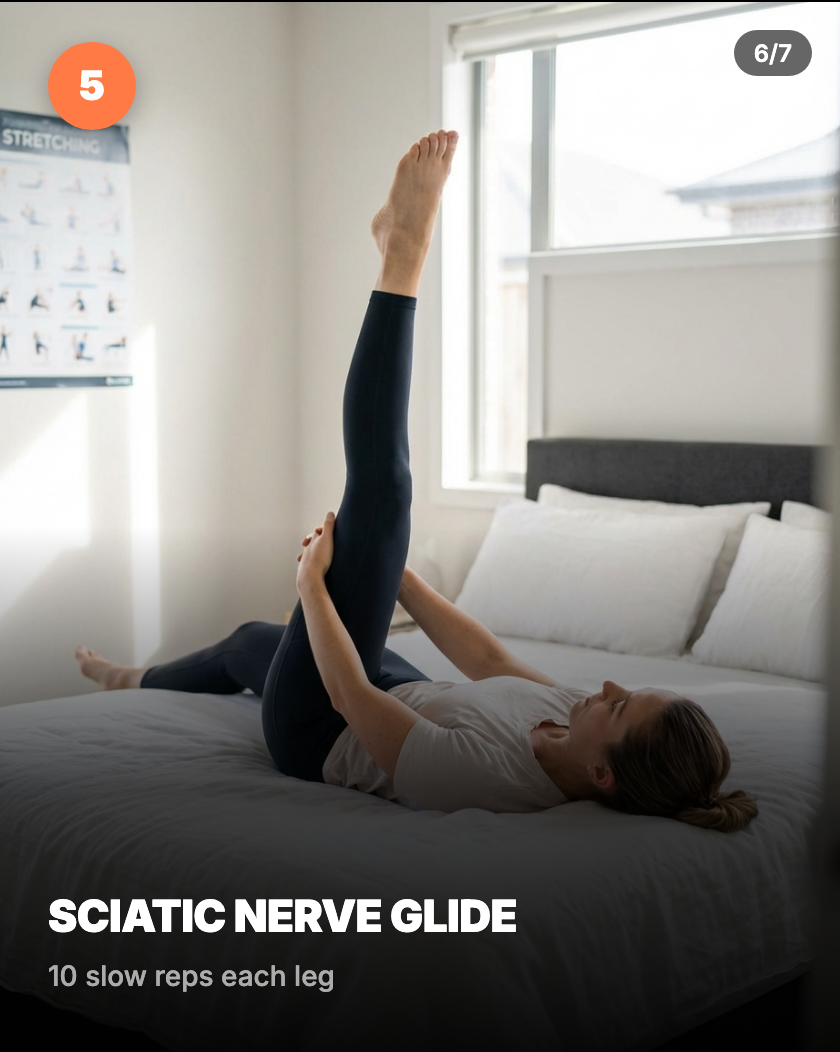
What it helps with Reducing nerve sensitivity and improving how the sciatic nerve moves through surrounding tissues. A 2012 randomized clinical trial (Albert & Manniche) found that systematic active conservative treatment — including nerve mobilization techniques — significantly improved outcomes for patients with severe sciatica compared to symptom-based management alone (PMID: 21494193).
How to do it
- Lie on your back with one leg raised toward the ceiling, hands behind your thigh for support.
- Slowly flex your foot (toes toward you) while straightening the knee as far as comfortable.
- Then point your foot and slightly bend the knee to release the tension.
Repetitions 10 slow repetitions each leg. Perform in a gentle, rhythmic motion.
When to stop Stop if the movement produces sharp or increasing pain. The glide should feel like a mild stretch or pulling sensation — not a stab.
How to Build a Morning Bed Routine
Perform these five exercises in order, every morning before getting up:
- Knee-to-Chest — 30 seconds each side (2 minutes total)
- Supine Piriformis Stretch — 30 seconds each side (2 minutes total)
- Pelvic Tilt — 10 reps (1 minute)
- Lying Spinal Twist — 30 seconds each side (2 minutes)
- Sciatic Nerve Glide — 10 reps each leg (2 minutes)
Total time: approximately 9 minutes.
After completing the routine, roll onto your side and push yourself up using your arms rather than sitting straight up — this protects your lower back during the transition.
When to See a Doctor
These exercises are appropriate for mild to moderate sciatica. Seek medical attention if you experience:
- Severe or sudden weakness in one or both legs
- Loss of bladder or bowel control — this may indicate cauda equina syndrome, a medical emergency
- Progressive numbness that spreads or worsens over days
- Pain that does not respond to conservative measures after 6–8 weeks
A 2021 randomized controlled trial (Fritz et al.) found that early referral to physical therapy for acute sciatica led to greater improvements in disability compared to primary care management alone, supporting the value of professional guidance alongside home exercise (PMID: 33017565).
Recovery Timeline
Most sciatica episodes improve within 4–8 weeks with consistent conservative management:
- Weeks 1–2: Focus on gentle pain relief. In-bed exercises, short walks, and avoiding prolonged sitting.
- Weeks 2–4: Gradually introduce more active stretches and basic core strengthening as tolerated.
- Weeks 4–8: Progress to standing exercises, glute bridges, and longer walks. Resume normal activities gradually.
For more exercise options as your recovery progresses, see our full guide on sciatica exercises. If you are looking for immediate pain management strategies, our sciatica pain relief guide covers additional approaches including heat therapy and positioning.
Summary
Morning sciatica pain does not have to dictate your entire day. Five simple exercises — performed in bed before you stand — can reduce nerve irritation, ease muscle stiffness, and prepare your body for movement. Start gently, stay consistent, and progress to more active exercises as your symptoms allow. If pain persists beyond a few weeks or worsens, consult a physiotherapist or your doctor for a tailored plan.