

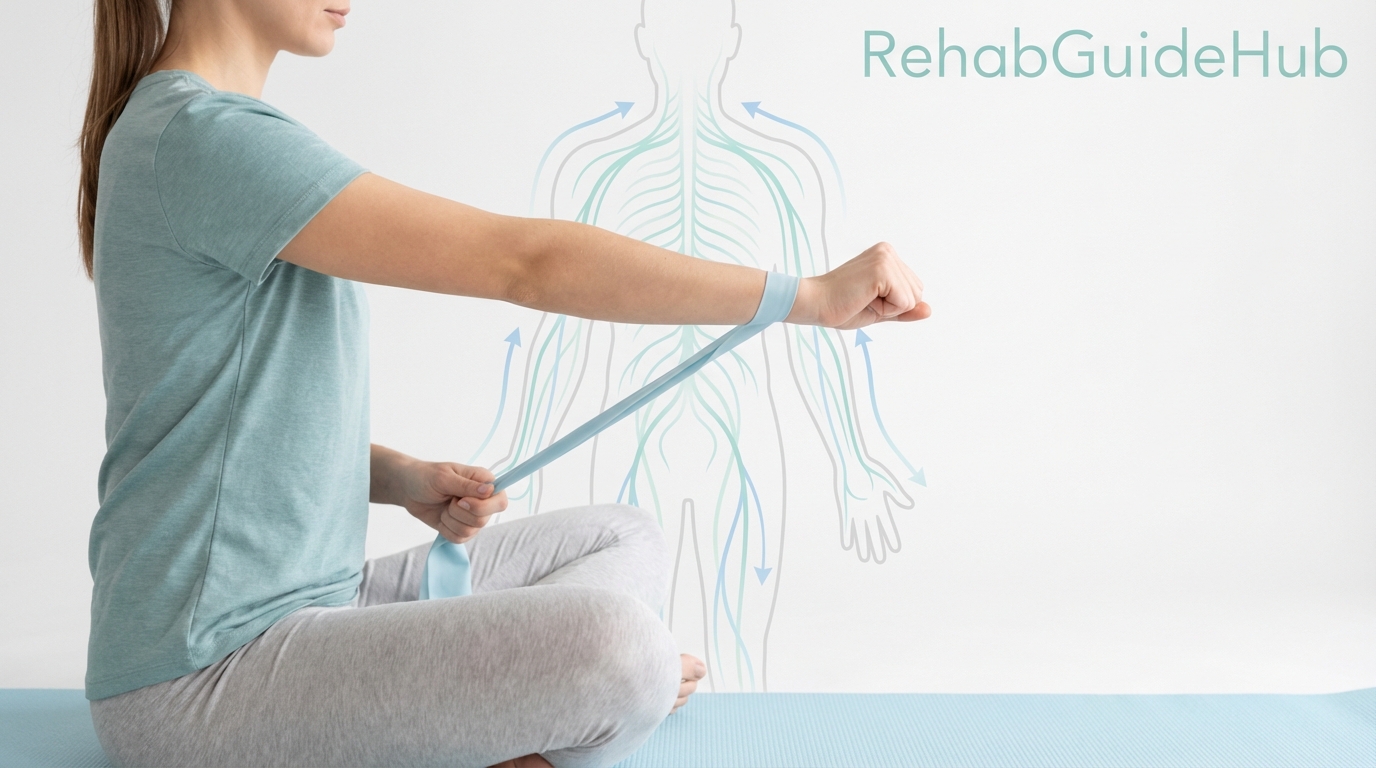
What Are Nerve Gliding Exercises?
Nerve gliding exercises — also called nerve flossing or neural mobilization — are gentle, controlled movements designed to help peripheral nerves slide smoothly through surrounding muscles, tendons, and connective tissue. When a nerve becomes compressed, irritated, or restricted in its movement, it can cause pain, tingling, numbness, or weakness along its path.
The goal of nerve gliding is not to stretch the nerve but to restore its normal mobility within the tissues it passes through. A 2017 systematic review and meta-analysis (Basson et al.) of 40 studies found that neural mobilization improved pain and disability outcomes across multiple neuromusculoskeletal conditions, with moderate-quality evidence supporting its use as part of a broader rehabilitation program.

These exercises are commonly prescribed by physiotherapists for conditions such as sciatica, carpal tunnel syndrome, cubital tunnel syndrome, and thoracic outlet syndrome. They are typically performed as part of a structured rehabilitation program alongside strengthening, stretching, and postural correction.
What Is Nerve Entrapment?
Nerve entrapment occurs when a peripheral nerve is compressed or restricted as it travels through a narrow anatomical space. This can happen at various points along the nerve's path, from the spine to the extremities.
Common nerve entrapment conditions include:
- Sciatica — compression of the sciatic nerve or its nerve roots in the lumbar spine, causing pain that radiates down the leg
- Carpal tunnel syndrome — compression of the median nerve at the wrist, causing numbness, tingling, and weakness in the hand
- Cubital tunnel syndrome — compression of the ulnar nerve at the elbow, causing numbness in the ring and little fingers
- Thoracic outlet syndrome — compression of nerves or blood vessels between the collarbone and first rib
- Piriformis syndrome — compression of the sciatic nerve by the piriformis muscle in the buttock
Symptoms vary depending on which nerve is affected but often include pain along the nerve's path, tingling or pins-and-needles sensations, numbness, and in more severe cases, muscle weakness.
What Causes Nerve Restriction?
Several factors can contribute to reduced nerve mobility and entrapment:
- Disc herniation or bulging — disc material pressing on a nerve root in the spine
- Repetitive strain — repeated motions that cause swelling and narrowing of nerve tunnels, common in the wrist and elbow
- Scar tissue formation — adhesions from surgery, injury, or chronic inflammation that restrict nerve gliding
- Poor posture — sustained positions that place prolonged tension on nerves, such as forward head posture affecting the brachial plexus
- Muscle tightness — hypertonic muscles compressing nearby nerves, as with piriformis syndrome
- Swelling or inflammation — conditions such as tendinitis or pregnancy-related fluid retention that reduce space around nerves
Understanding the underlying cause is important because it determines which nerve gliding exercises are appropriate and how they should be progressed.
Best Nerve Gliding Exercises by Region
The exercises below are organized by the nerve and body region they target. A 2023 systematic review (Peacock et al.) found that adding neural mobilization to conventional treatment improved pain, disability, and straight leg raise outcomes in patients with low back and radicular pain.
Sciatic Nerve Glide (Seated)
This exercise targets the sciatic nerve, which runs from the lower back through the buttock and down the leg. It is commonly used in sciatica rehabilitation programs.
- Sit upright on a chair with both feet flat on the floor
- Slowly straighten one leg by extending the knee while simultaneously looking upward (chin to ceiling)
- Then bend the knee back down while tucking the chin toward the chest
- Alternate these movements in a smooth, rhythmic motion
- Perform 10–15 repetitions per leg, 2–3 times per day
What it may help with: Reducing sciatic nerve sensitivity and improving nerve mobility in the lower extremity.
Common mistakes: Jerking the leg outward too quickly, holding at end range, or performing the exercise during a severe acute flare-up.
Sciatic Nerve Glide (Supine)
A gentler alternative that may be more comfortable during acute episodes.
- Lie on your back and hold one thigh with both hands, hip bent to approximately 90 degrees
- Slowly straighten the knee while pulling the toes toward you (dorsiflexion)
- Stop before pain significantly increases, then bend the knee back
- Repeat 10–15 times in a controlled rhythm
Median Nerve Glide (for Carpal Tunnel Syndrome)
The median nerve runs from the neck through the arm and into the hand. A 2017 systematic review (Ballestero-Pérez et al.) found that nerve gliding exercises showed improvements in pain and function in patients with carpal tunnel syndrome, particularly when combined with other conservative treatments.
- Stand or sit with your arm at your side, elbow bent to 90 degrees, and wrist in neutral
- Slowly extend the wrist and fingers back (as if signaling "stop") while straightening the elbow
- Then flex the wrist and fingers into a fist while bending the elbow back
- Move smoothly between these two positions for 10–15 repetitions
- Perform 2–3 times per day
What it may help with: Improving median nerve mobility through the carpal tunnel and reducing tingling and numbness in the thumb, index, and middle fingers.
Common mistakes: Gripping too hard during the fist position, moving too quickly, or pushing into sharp pain.
Ulnar Nerve Glide (for Cubital Tunnel Syndrome)
This targets the ulnar nerve, which passes behind the inner elbow.
- Stand or sit upright with your arm at your side
- Bend the elbow fully, bringing your hand toward your shoulder with the wrist flexed and palm facing you
- Then straighten the elbow and extend the wrist, turning the palm away from you
- Alternate smoothly for 10–15 repetitions
- Perform 2–3 times per day
What it may help with: Reducing compression-related symptoms in the ring and little fingers, and improving ulnar nerve mobility at the elbow.
Radial Nerve Glide
The radial nerve travels along the back of the arm. It can become entrapped near the elbow or wrist.
- Stand with your arm at your side, shoulder relaxed
- Internally rotate the shoulder so your thumb points inward, then flex the wrist so the back of your hand faces forward
- Gently tilt your head away from the affected arm to add neural tension
- Then tilt the head back toward the arm while extending the wrist
- Repeat 10–15 times in a controlled motion
Nerve Gliding for Plantar Fasciitis and Foot Pain
The tibial nerve and its branches can contribute to heel and foot pain, sometimes mimicking or coexisting with plantar fasciitis. Nerve gliding exercises for the lower leg may complement standard plantar fasciitis rehabilitation.
Tibial Nerve Glide
- Sit on a chair and extend one leg forward, resting the heel on the floor
- Pull the toes and ankle toward you (dorsiflexion) while extending the knee
- Then point the toes away while bending the knee slightly
- Repeat 10–15 times per leg
When to Avoid Nerve Gliding Exercises
Nerve gliding exercises are generally safe when performed correctly, but there are situations where they should be avoided or modified:
- Acute nerve injury — if you have a diagnosed nerve laceration, severe compression, or recent surgical repair, nerve gliding should only be performed under direct clinical supervision
- Worsening symptoms — if the exercise consistently increases pain, numbness, or tingling further along the nerve path (peripheralization), stop and consult a physiotherapist
- Cauda equina symptoms — loss of bowel or bladder control, saddle area numbness, or progressive bilateral leg weakness require emergency medical evaluation, not exercise
- Acute inflammatory conditions — during active flare-ups of inflammatory conditions such as rheumatoid arthritis, nerve gliding may aggravate inflamed tissues
- Severe or progressive neurological deficits — worsening muscle weakness or loss of reflexes warrants medical investigation before beginning exercise
A key principle: nerve gliding should feel like a gentle pulling or mild tension, never sharp or electric pain. If an exercise reproduces your symptoms intensely, reduce the range of motion or stop.
Recovery Timeline
Recovery expectations depend on the underlying condition and severity of nerve involvement. A randomized controlled trial (Abdolrazaghi et al., 2023) found that patients with mild carpal tunnel syndrome who performed nerve and tendon gliding exercises showed significant improvements in symptoms and grip strength over a follow-up period.
General timelines for common nerve entrapment conditions:
- Mild nerve irritation — many people notice improvement within 2–4 weeks of consistent nerve gliding combined with activity modification
- Moderate entrapment (e.g., mild carpal tunnel, piriformis syndrome) — 4–8 weeks of structured rehabilitation including nerve gliding, strengthening, and ergonomic changes
- Chronic or severe entrapment — may require 3–6 months of conservative management; some cases may ultimately need surgical consultation
- Post-surgical nerve recovery — nerve gliding is often introduced 2–6 weeks after surgery depending on the procedure, with recovery spanning several months
Recovery is not always linear. Consistency with gentle nerve gliding, combined with addressing the underlying cause (posture, workstation setup, muscle imbalances), tends to produce the best outcomes.
FAQ
What is the difference between nerve gliding and nerve stretching?
Nerve gliding involves alternating tension at one end of the nerve while releasing it at the other, allowing the nerve to slide back and forth through tissues. Nerve stretching applies tension along the entire nerve simultaneously. Gliding is generally safer and better tolerated, especially in the early stages of rehabilitation. Most physiotherapy protocols prefer gliding over stretching for irritated nerves.
How often should I do nerve gliding exercises?
Most physiotherapy protocols recommend performing nerve gliding exercises 2–3 times per day, with 10–15 repetitions per session. The movements should be gentle and rhythmic. Overdoing nerve gliding — performing too many repetitions or pushing into pain — can increase nerve irritation rather than reduce it.
Can nerve gliding exercises help with sciatica?
Yes. Nerve gliding is a common component of sciatica rehabilitation. A systematic review (Peacock et al., 2023) found that neural mobilization added to conventional treatment improved pain and disability in patients with low back and radicular pain. Sciatic nerve glides are typically combined with extension exercises and core stabilization for the best outcomes.
Do nerve gliding exercises work for carpal tunnel syndrome?
Research supports nerve gliding as part of conservative carpal tunnel treatment. A systematic review (Ballestero-Pérez et al., 2017) found that nerve gliding exercises improved pain and function in carpal tunnel patients, particularly when combined with splinting and activity modification. However, severe carpal tunnel syndrome with significant muscle wasting may require surgical evaluation.
How long does it take for nerve gliding to work?
Mild nerve irritation may improve within 2–4 weeks. More established entrapment conditions like moderate carpal tunnel syndrome typically respond over 4–8 weeks of consistent exercise combined with other interventions. If you have not noticed any improvement after 4–6 weeks of regular nerve gliding, consult a physiotherapist or physician for further evaluation.
Can I do nerve gliding exercises on my own?
Nerve gliding exercises are safe to perform independently once you have been assessed by a physiotherapist and given appropriate exercises for your specific condition. Starting without a proper diagnosis may lead to performing the wrong exercises or aggravating your condition. A physiotherapist can identify which nerve is involved and prescribe the correct gliding technique.
References
- Basson A, Olivier B, Ellis R, et al. The Effectiveness of Neural Mobilization for Neuromusculoskeletal Conditions: A Systematic Review and Meta-analysis. Journal of Orthopaedic & Sports Physical Therapy. 2017;47(9):593-615. PMID: 28704626.
- Ballestero-Pérez R, Plaza-Manzano G, Urraca-Gesto A, et al. Effectiveness of Nerve Gliding Exercises on Carpal Tunnel Syndrome: A Systematic Review. Journal of Manipulative and Physiological Therapeutics. 2017;40(1):50-59. PMID: 27842937.
- Peacock M, Douglas S, Nair P. Neural mobilization in low back and radicular pain: a systematic review. Journal of Manual & Manipulative Therapy. 2023;31(1):4-12. PMID: 35583521.
- Abdolrazaghi HA, Khansari M, Mirshahi M, Ahmadi Pishkuhi M. Effectiveness of Tendon and Nerve Gliding Exercises in the Treatment of Patients With Mild Idiopathic Carpal Tunnel Syndrome: A Randomized Controlled Trial. Hand (N Y). 2023;18(2):222-229. PMID: 33855879.
Looking for guided nerve recovery programs? Join the RehabGuideHub early access list for structured rehabilitation programs built with physiotherapy expertise.