

Sciatica does not discriminate by age, but managing it in your 60s, 70s, or beyond requires a different approach than what works for younger adults. Floor exercises may not be practical. Balance can be a concern. And the underlying cause is often spinal stenosis rather than a herniated disc — which changes which movements help and which ones make things worse. This guide focuses on safe, gentle exercises that older adults can perform with confidence, many of them using nothing more than a sturdy chair.

Why Sciatica Is Different in Older Adults
In younger people, sciatica is most commonly caused by a herniated disc. In older adults, the leading cause shifts to lumbar spinal stenosis — a gradual narrowing of the spinal canal that compresses the nerve roots. This distinction matters because:
- Extension (arching the back) tends to narrow the canal further, potentially worsening symptoms
- Mild flexion (slight forward lean) tends to open the canal and provide relief
- Walking tolerance is often limited — a hallmark of neurogenic claudication
- Balance and fall risk must be considered in every exercise selection
A 2025 narrative review (Ammendolia) on non-operative treatments for older adults with lumbar spinal stenosis emphasized that clinical practice guidelines recommend manual therapy, exercise, and education as first-line approaches — but noted that guidelines lack practical detail on how to apply these interventions for this population (PMID: 40691793).
What Is Sciatica?
Sciatica describes pain that radiates along the sciatic nerve — from the lower back through the buttock and down the leg. In older adults, it commonly presents as:
- Leg pain or heaviness when walking or standing
- Relief when sitting or leaning forward (e.g., over a shopping cart)
- Numbness or tingling in one or both legs
- Difficulty walking longer distances
For a complete overview, see our sciatica condition page.
5 Chair-Based Sciatica Exercises for Seniors
These exercises can be performed seated in a sturdy chair with armrests or while standing with the chair as support. No floor work is required.
A 2014 analysis of the SPORT study (Fritz et al.) found that physical therapy was associated with improved long-term outcomes for individuals with lumbar spinal stenosis, including better walking capacity and reduced disability (PMID: 24373681).
Seated Knee Hug
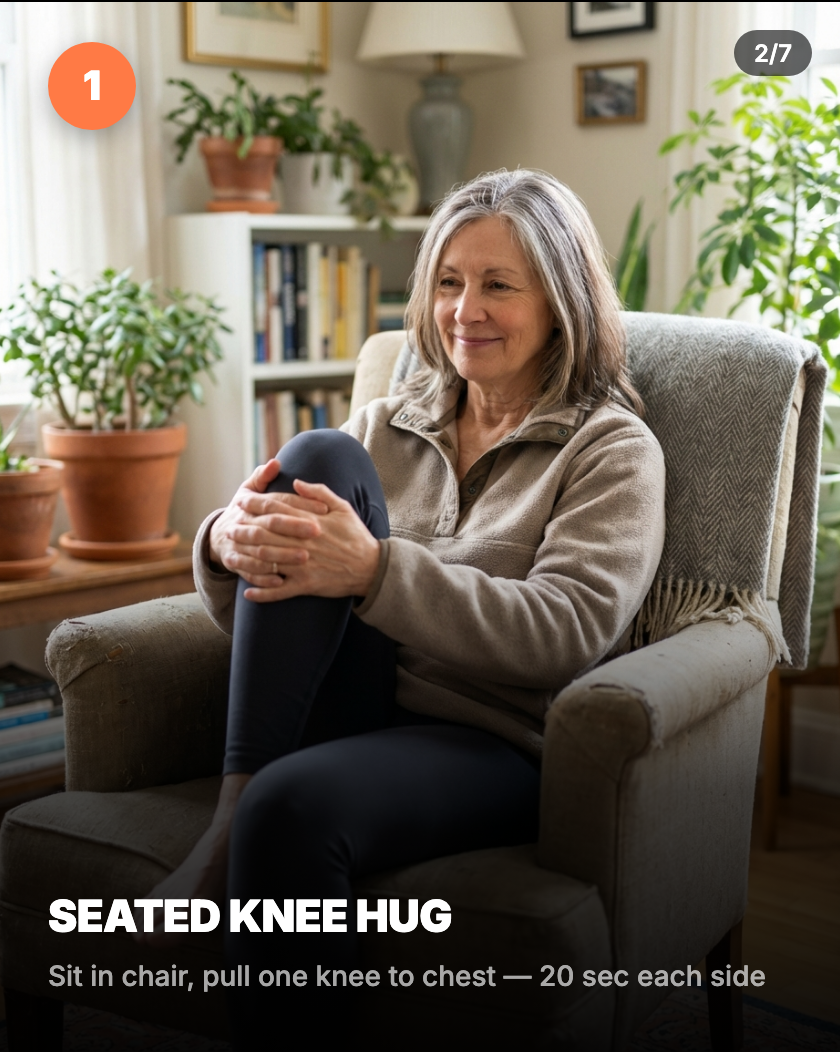
What it helps with Gently flexing the lumbar spine to open the spinal canal, which can reduce pressure on compressed nerve roots — particularly effective for stenosis-related sciatica.
How to do it
- Sit upright in a sturdy chair with both feet flat on the floor.
- Place both hands behind one knee.
- Gently pull that knee toward your chest, rounding your lower back slightly.
Repetitions Hold for 20 seconds each side. Repeat 3 times.
When to stop Stop if pulling the knee causes sharp pain in the hip joint or increases leg symptoms.
Seated Ankle Circles
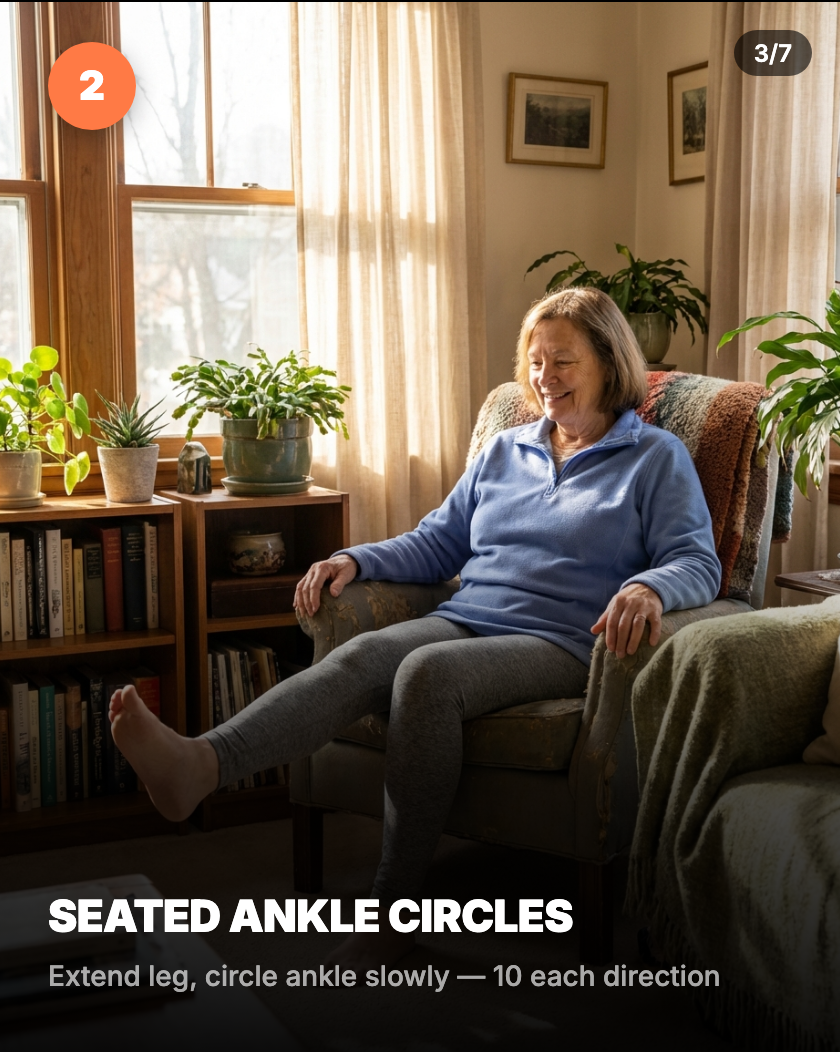
What it helps with Promoting blood flow to the lower legs, gently mobilizing the sciatic nerve through ankle and calf movement, and maintaining joint mobility in the feet and ankles.
How to do it
- Sit upright and extend one leg out in front of you.
- Slowly rotate your foot in large circles — 10 in each direction.
- Switch legs and repeat.
Repetitions 10 circles in each direction, each leg.
When to stop Stop if the extended leg position increases sciatica symptoms. Try bending the knee slightly to reduce nerve tension.
Supported Standing Stretch
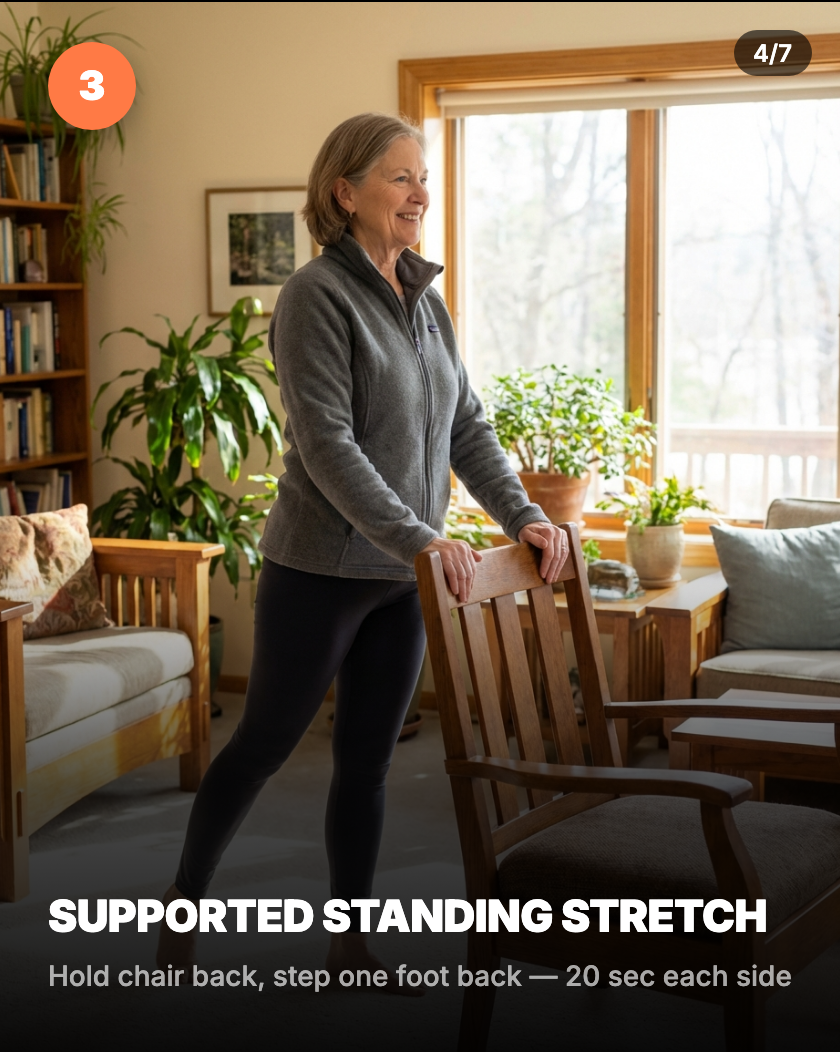
What it helps with Stretching the calf and hip flexor while maintaining balance support — tight calves and hip flexors can alter gait patterns and increase strain on the lower back.
How to do it
- Stand behind a sturdy chair, holding the backrest with both hands.
- Step one foot back into a gentle lunge position, keeping both feet flat.
- Lean slightly forward, feeling the stretch in the back leg's calf and hip flexor.
Repetitions Hold for 20 seconds each side. Repeat 2–3 times.
When to stop Stop if you feel unsteady even with the chair support, or if the position increases leg pain.
Gentle Seated Twist
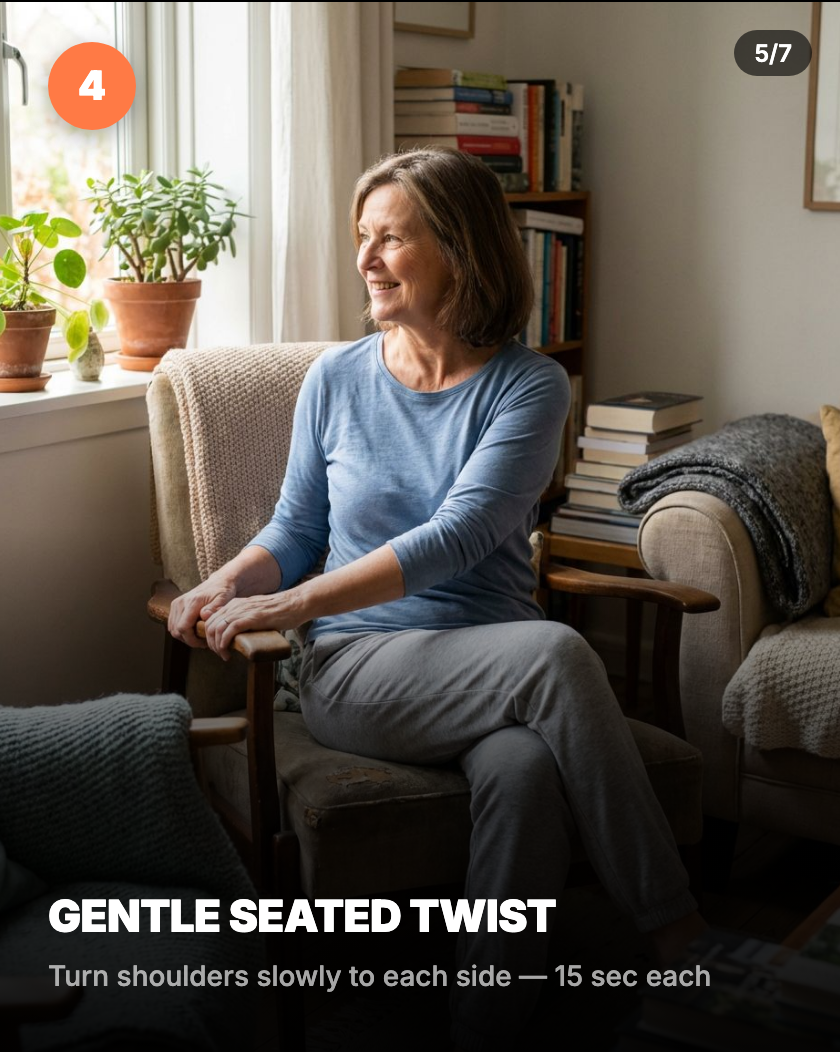
What it helps with Mobilizing the thoracic spine and releasing tension in the muscles around the lower back and hips. A controlled twist can improve rotational mobility without stressing the lumbar discs.
How to do it
- Sit upright with your feet flat on the floor.
- Place one hand on the opposite knee and the other on the armrest behind you.
- Slowly rotate your upper body to one side, keeping your hips facing forward.
Repetitions Hold for 15 seconds each side. Repeat 2–3 times.
When to stop Stop if the twist increases leg pain or produces sharp sensations in the lower back. Keep the movement gentle — the goal is mild rotation, not maximum range.
Marching in Place
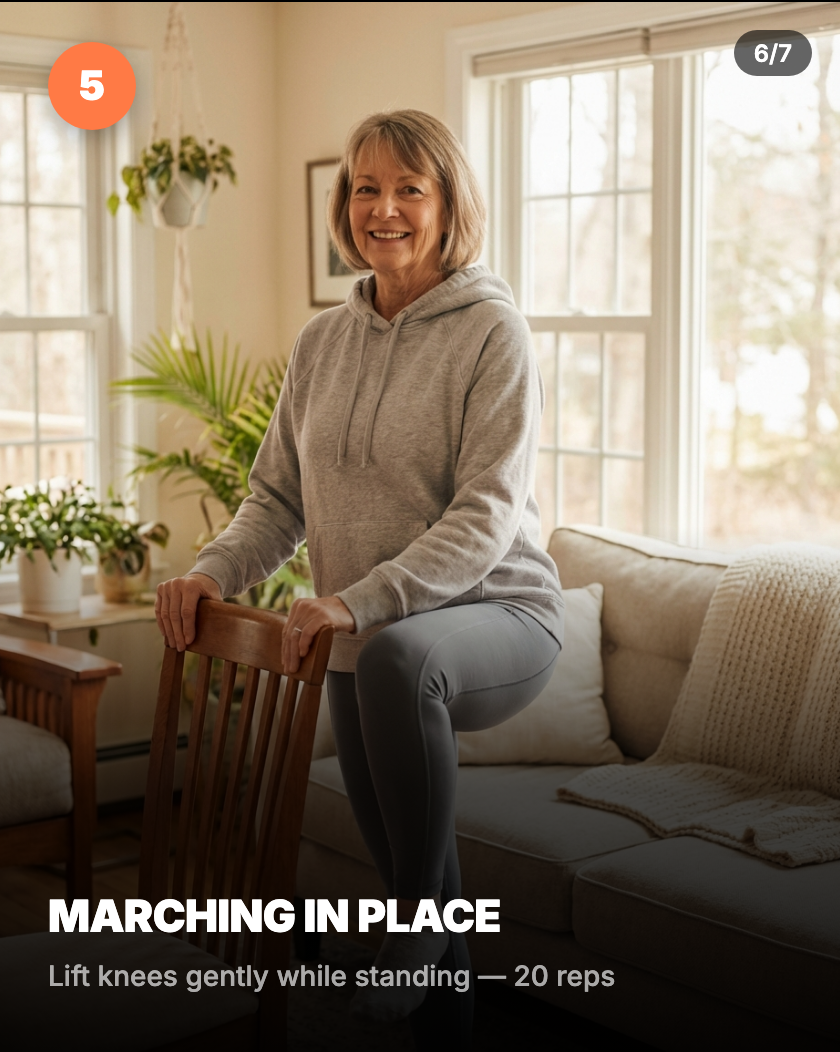
What it helps with A light cardiovascular warm-up that activates the hip flexors, promotes circulation to the lower limbs, and gently challenges balance in a controlled way.
How to do it
- Stand next to a sturdy chair, resting one hand on the backrest for balance.
- Lift one knee gently to a comfortable height — you do not need to go high.
- Lower and alternate legs in a controlled marching motion.
Repetitions 20 repetitions total (10 each leg). Rest briefly, then repeat for a second set.
When to stop Stop if you feel dizzy, unsteady, or if marching increases leg pain. Reduce the knee height if needed.
Additional Gentle Exercises
Once the chair-based exercises feel comfortable, consider adding these beginner-level movements from our related carousel guide:

- Seated Forward Fold — sit on the floor with legs extended, reach gently for your toes (hold 20 seconds)
- Knee Hug — lie on your back and hug both knees to your chest (hold 20 seconds)
- Gentle Cat Stretch — on hands and knees, round your back upward (hold 10 seconds, repeat 5 times)
- Supported Bridge — lying on your back, lift hips slightly (hold 10 seconds, repeat 5 times)
Only attempt floor-based exercises if you can safely get down and back up, or with assistance.
Safety Considerations for Seniors
A 2023 Delphi consensus study (Thoomes et al.) on conservative management of lumbar radiculopathy emphasized that treatment should be matched to the stage of the disorder — with gentler, more supportive approaches recommended during the acute and sub-acute phases (PMID: 36205564). For seniors, this principle is especially important:
- Always use support — a chair, wall, or countertop for standing exercises
- Avoid deep extension — arching the back can narrow the spinal canal in stenosis
- Move slowly — jerky movements increase fall risk and can aggravate nerve irritation
- Listen to your body — mild discomfort during stretching is acceptable; sharp pain is not
- Stay hydrated — dehydrated discs and muscles recover more slowly
- Check with your doctor if you have osteoporosis, severe arthritis, or a history of spinal surgery
When to See a Doctor
Seek medical attention if you experience:
- Severe or sudden weakness in one or both legs
- Loss of bladder or bowel control — this may indicate cauda equina syndrome
- Progressive numbness that worsens over days
- Inability to walk due to pain or weakness
- Symptoms that do not improve after 6–8 weeks of conservative management
A 2025 secondary analysis of a randomized controlled trial (Roseen et al.) found that certain patient characteristics — including symptom duration and baseline function — predicted who would benefit most from nonsurgical treatment for lumbar spinal stenosis, reinforcing the value of professional assessment (PMID: 41366694).
Recovery Timeline
Recovery timelines for seniors may be longer than for younger adults, but steady improvement is achievable:
- Weeks 1–3: Chair-based exercises, short walks (5–10 minutes), avoid prolonged standing
- Weeks 3–6: Gradually increase walking distance, add gentle floor exercises if safe
- Weeks 6–12: Build toward 20–30 minute walks, introduce light strengthening
For more exercise options, see our full guide on sciatica exercises. For approaches that can be done from bed, see our guide on sciatica exercises in bed.
Summary
Sciatica in older adults requires exercises that respect the body's changing needs — prioritizing safety, using support, and favoring gentle flexion-based movements over aggressive stretching. Chair-based exercises offer an accessible starting point that most seniors can perform independently. Consistency over weeks matters more than intensity on any single day. If symptoms persist or worsen, professional guidance from a physiotherapist familiar with geriatric rehabilitation can make a significant difference.