

When sciatica strikes, the instinct to stretch it out is understandable — but the wrong stretch at the wrong time can turn a manageable flare-up into weeks of worsening pain. Certain movements increase pressure on herniated discs, overstretch an already irritated nerve, or force the spine into positions that narrow the space around nerve roots. Knowing what to avoid is just as important as knowing what to do.

Why Some Exercises Make Sciatica Worse
Sciatica pain comes from irritation of the sciatic nerve — usually caused by a herniated disc, spinal stenosis, or piriformis syndrome. Each of these conditions responds differently to movement:
- Disc herniation: Flexion (forward bending) pushes disc material further toward the nerve root. Extension (arching) tends to draw it away.
- Spinal stenosis: Extension narrows the spinal canal further. Flexion tends to open it.
- Piriformis syndrome: Deep hip rotation can compress the nerve where it passes through the buttock.
A 2024 randomized clinical trial (Kilpikoski et al.) comparing the McKenzie Method with guideline-based advice in patients with sciatica found that directional preference — identifying which movements help and which ones aggravate — was a key factor in treatment success over 24 months (PMID: 37605454).
This means there is no universal list of "bad" exercises — what harms one person may help another. The guidance below focuses on movements that are most commonly problematic during active sciatica symptoms.
Exercises to Avoid During a Sciatica Flare-Up
1. Heavy Hamstring Stretches
Why they aggravate sciatica Aggressive hamstring stretching — like bending forward to touch your toes or pulling a straight leg toward your chest — puts direct tension on the sciatic nerve. During a flare-up, the nerve is already irritated, and adding stretch tension can amplify pain signals and slow recovery.
The mistake Locking the knee completely straight while pulling the leg as high as possible.
What to do instead Use a gentle sciatic nerve glide: extend the knee while flexing the foot, then bend the knee while pointing the foot. This moves the nerve through surrounding tissues without holding it under sustained tension.
2. Sit-Ups, Crunches, and Leg Raises
Why they aggravate sciatica Traditional abdominal exercises create significant lumbar flexion load — compressing the front of the spinal discs and pushing disc material toward the nerve roots. Double leg raises are particularly risky because they combine flexion with heavy hip flexor engagement, pulling the lumbar spine into an exaggerated arch.
The mistake Using these exercises as "core strengthening" during active sciatica.
What to do instead Activate the core without spinal flexion. Pelvic tilts, bird dogs, and dead bugs strengthen the deep stabilizers — transversus abdominis and multifidus — without compressing the discs.
3. Loaded Forward Bends
Why they aggravate sciatica Deadlifts, good mornings, and weighted toe touches combine spinal flexion with heavy load. This is the highest-risk scenario for disc-related sciatica: the disc is compressed under load while the spine is in the position most likely to push disc material into the nerve root.
The mistake Returning to these exercises too early in recovery, or rounding the back during the movement.
What to do instead Focus on hip hinge movements with bodyweight first — wall slides, Romanian deadlift patterns with no weight — and only reintroduce load once leg symptoms have fully resolved and a physiotherapist has cleared you.
4. High-Impact Activities
Why they aggravate sciatica Running, jumping, plyometrics, and high-impact aerobics create repetitive compressive forces through the spine. Each impact transmits shock through the lumbar discs, which can re-irritate a sensitive nerve root.
The mistake Using running as a way to "loosen up" a stiff lower back during a sciatica episode.
What to do instead Walk instead. Walking provides gentle, rhythmic movement that promotes blood flow and nerve health without high compressive forces. A 2016 systematic review and meta-analysis (Fernandez et al.) found that physical activity — including walking — was comparable to surgery for managing sciatica symptoms in appropriately selected patients (PMID: 26210309).
5. Deep Twisting Under Load
Why it aggravates sciatica Rotational movements combined with compression — such as Russian twists with a weight, rotational cable pulls, or aggressive yoga twists — can shear the disc and irritate the nerve root. The lumbar spine has limited rotational capacity by design.
The mistake Forcing maximum rotation or adding weight to twisting movements during a flare.
What to do instead Use gentle, unloaded spinal rotations. A lying spinal twist with knees bent and no external force allows controlled mobility without dangerous shearing.
Correct Form: Do This, Not That
Proper technique makes the difference between an exercise that helps and one that harms. Here are the most common form corrections:
Knee-to-Chest: Gentle Pull
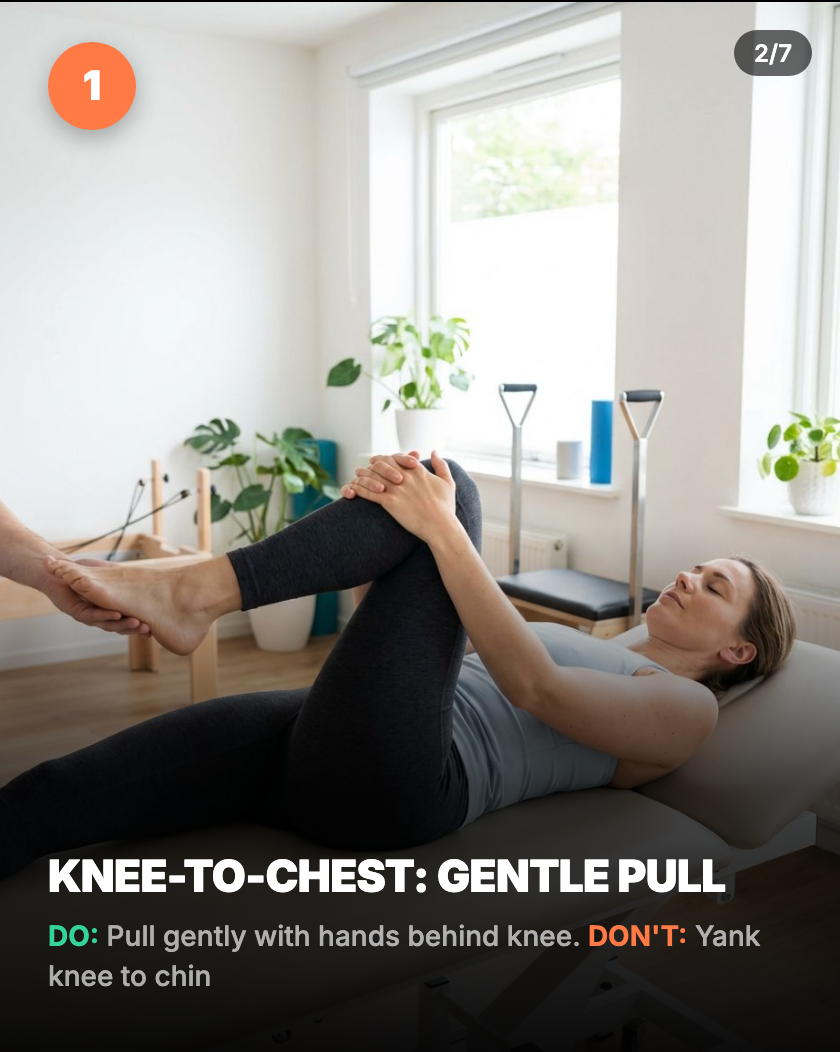
Do: Pull gently with hands behind the knee, not on top of it. Keep the movement controlled. Don't: Yank the knee toward your chin or use momentum.
Piriformis Stretch: Hips Down
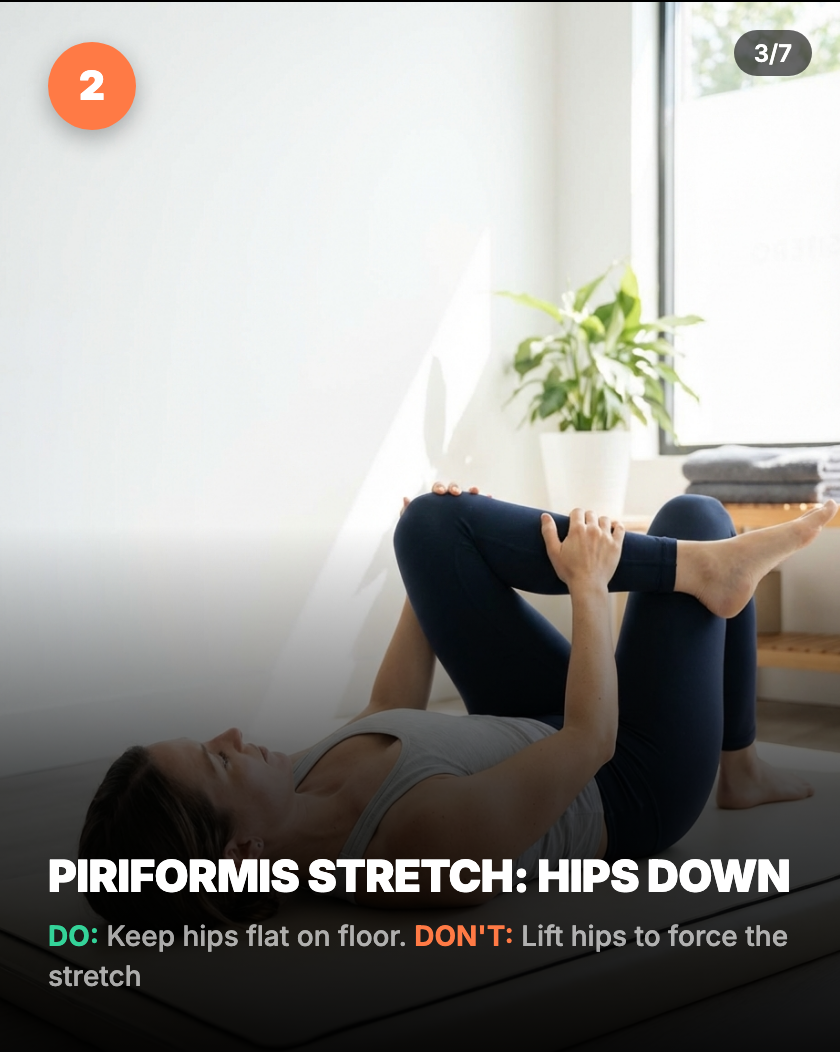
Do: Keep both hips flat on the floor throughout the stretch. Don't: Lift your hips off the floor to force the stretch deeper — this rotates the pelvis and can compress the nerve.
Hamstring Stretch: Soft Knee
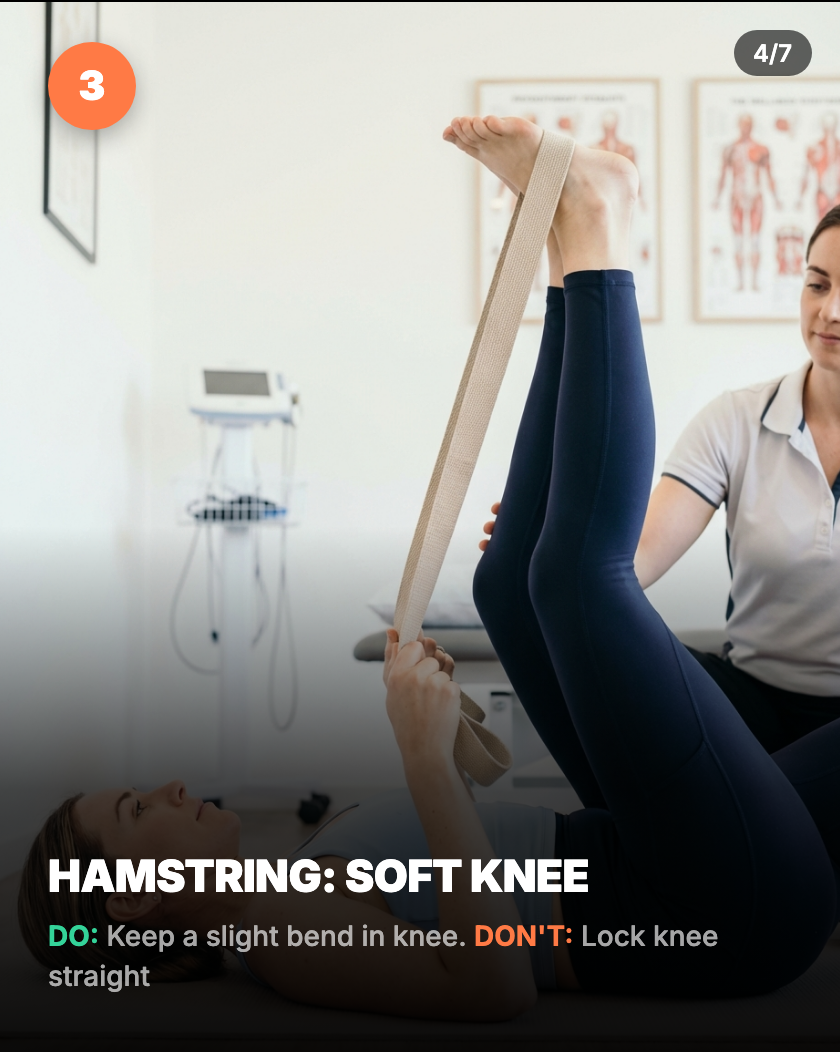
Do: Keep a slight bend in the knee to reduce direct tension on the sciatic nerve. Don't: Lock the knee completely straight — this maximizes nerve tension and can worsen symptoms.
Spinal Twist: Shoulders Down
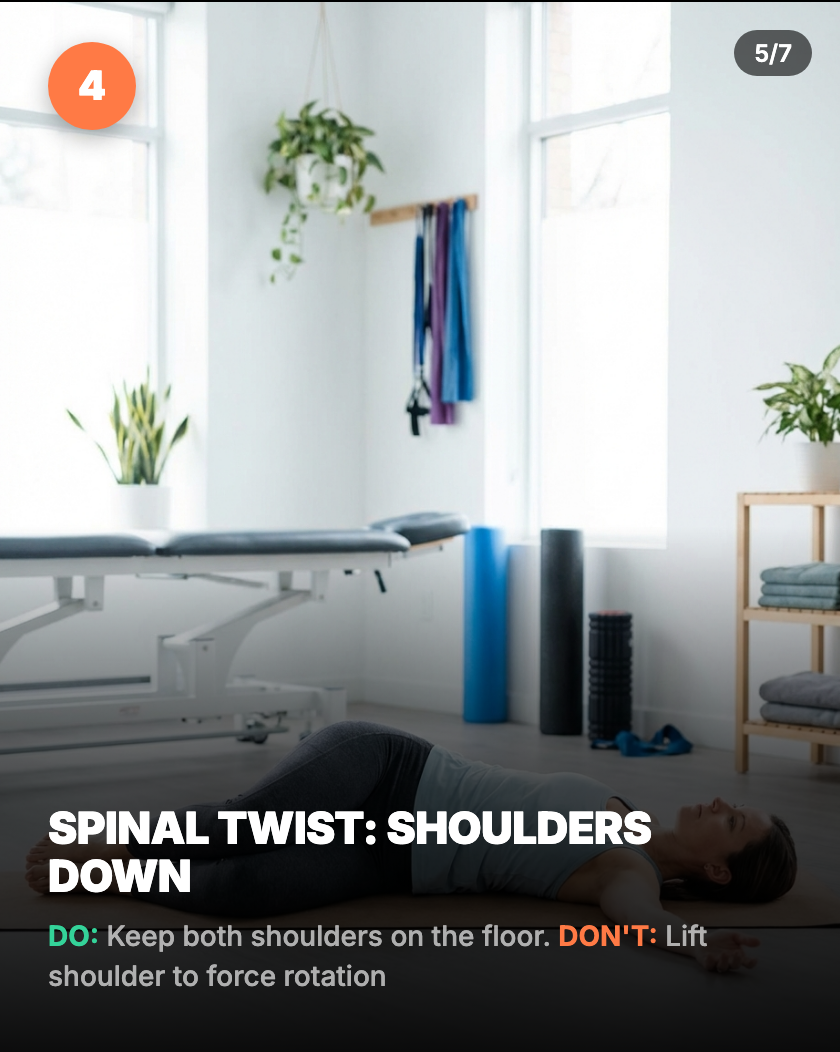
Do: Keep both shoulders pressed flat on the floor and let the knees fall only as far as comfortable. Don't: Lift a shoulder to force the rotation — this transfers the twist into the lumbar spine where it can aggravate disc issues.
Nerve Glide: Slow Motion
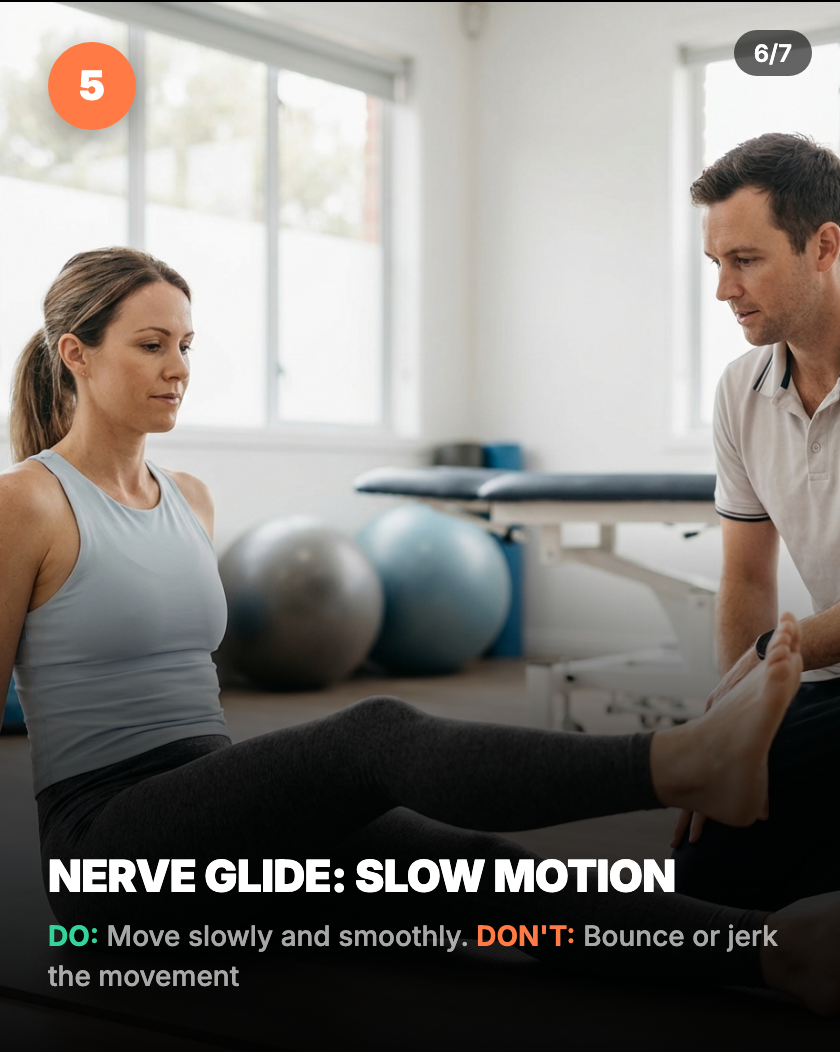
Do: Move slowly and smoothly, coordinating knee extension with foot flexion in a gentle rhythm. Don't: Bounce, jerk, or rush the movement — the sciatic nerve responds poorly to sudden or aggressive mobilization.
Understanding Peripheralization
One rule applies across all exercises: if pain moves further down the leg, stop immediately.
This phenomenon — called peripheralization — means the nerve is being further irritated. It is the most important warning sign during any exercise:
- Pain moving from the buttock into the thigh = stop and reassess
- Pain moving from the thigh into the calf or foot = stop and consult a professional
- Numbness or tingling appearing during exercise = stop immediately
The opposite — centralization — is a positive sign. If leg pain moves upward toward the lower back during a movement, it typically means pressure on the nerve is decreasing.
A 2023 Delphi consensus study (Thoomes et al.) on conservative management of lumbar radiculopathy emphasized that treatment should be matched to the stage of the disorder and that recognizing centralization and peripheralization patterns is essential for safe exercise prescription (PMID: 36205564).
When to See a Doctor
Stop exercising and seek medical attention if you experience:
- Sudden severe weakness in one or both legs
- Loss of bladder or bowel control — possible cauda equina syndrome
- Progressive numbness that spreads or worsens
- Pain that worsens significantly despite avoiding aggravating movements
A 2025 network meta-analysis (Zhu et al.) of 50 randomized controlled trials found that while several non-surgical approaches showed benefits for chronic sciatica, the evidence highlights the importance of individualized treatment — reinforcing why professional assessment matters when symptoms are not improving (PMID: 40373933).
Recovery Timeline
With appropriate exercise selection, most sciatica episodes improve within 4–8 weeks:
- Weeks 1–2: Avoid all aggravating movements. Focus on gentle stretches: pelvic tilts, knee-to-chest, prone lying.
- Weeks 2–4: Introduce nerve glides, extension exercises, and basic core activation with correct form.
- Weeks 4–8: Gradually reintroduce more active movements. Add walking distance progressively.
For safe, recommended exercises, see our full guide on sciatica exercises. For in-bed morning routines, visit sciatica exercises in bed.
Summary
The most important rule in sciatica rehabilitation is not which exercises you do — it is which ones you avoid. Heavy hamstring stretches, sit-ups, loaded forward bends, high-impact activities, and forced twists can all aggravate an irritated sciatic nerve. Focus on gentle, controlled movements with correct form, watch for peripheralization, and match your exercise intensity to your stage of recovery. When in doubt, less is more.